Legal insight
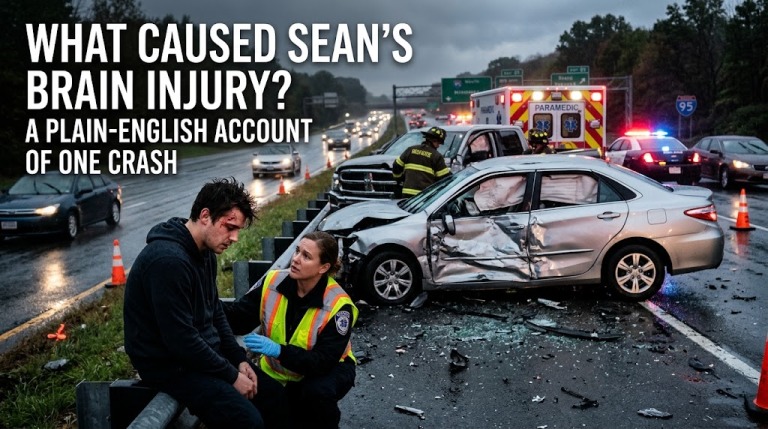
What Caused Sean’s Brain Injury? A Plain-English Account of One Crash
What Caused Sean's Brain Injury On this page The short answer The night of the crash A head that hit nothing The chain of causes Common wrong answers The other injuries How doctors confirmed it Recovery Other causes of brain…
Case explainer · Traumatic brain injury
What Caused Sean’s Brain Injury? A Plain-English Account of One Crash
People search for what caused Sean’s brain injury for different reasons. Some are studying for a safety course. Some are curious about a story they heard at a school assembly. Some have a family member with a similar injury and are trying to understand how a person can end up this hurt without ever hitting their head. Whatever brought you here, this page lays out the answer and the reasoning behind it.
The short answer
When people ask what caused Sean’s brain injury, the answer is a drunk-driving crash. Sean was a passenger in a pickup truck whose intoxicated driver lost control. The truck spun and slammed into a tree on the exact side where Sean sat. His head did not strike the tree, the window, or the dash. It moved violently from side to side as the truck stopped, and his brain shifted and twisted inside his skull. That produced a severe diffuse axonal injury, a widespread tearing and stretching of the brain’s nerve fibers.
So the direct cause was rapid, forceful motion of the head and brain. The larger cause was a driver who should never have been behind the wheel.
- Who
- Sean Carter, then a 22-year-old college student
- When
- Early hours of March 27, 2005
- Where
- Wichita Falls, Texas
- Injury
- Severe diffuse axonal injury
- Coma
- 39 days
The night of the crash, piece by piece
Most of what is known about that night has been pieced together by Sean’s mother, Jenny Carter, from police and medical records, toxicology results and what others later told the family. Sean himself has no memory of it. That is common after a serious brain injury, and it matters, because it means the story of his injury is told by the people who reconstructed it.
Sean was attending Midwestern State University, working while he studied, and planned to go on to law school. On the Saturday night before Easter he went out with two friends. They visited a couple of bars, and all three drank. The toxicology report later showed Sean was over the legal limit. The friend who drove that night was, by the family’s account, more intoxicated than Sean.
- Late Saturday nightThree friends leave a bar in a Dodge Ram pickup. The driver, the heaviest drinker of the group, takes the wheel. Sean sits on the bench seat, seat belt fastened, next to the passenger door.
- Roughly five minutes from homeIt was raining. The driver lost control, and the truck spun. Its passenger side hit a tree where Sean was sitting.
- The moment of impactSean’s body could not move toward the door because the other two men were beside him and his belt held him in place. The entire right side of his body took the force. His head, however, kept traveling.
- On sceneFire and rescue crews arrived quickly and had to cut him out of the wreck. Sean was unresponsive.
- Local emergency roomHe arrived at United Regional Hospital in Wichita Falls with a Glasgow Coma Scale score of 3, the lowest score possible.
- Level 1 trauma centerAfter stabilization, he was moved by ambulance to Parkland Hospital in Dallas, where doctors confirmed the traumatic brain injury.
Every detail in that sequence points the same direction. There was alcohol, speed on a wet road, a loss of control, and a solid object. Nothing about it was a freak event, and that is exactly why it is used in safety education today.
How a head that hit nothing still ends up with a brain injury
Here is the part that surprises people. Sean’s family has said repeatedly that his head never hit anything and nothing hit his head. If you picture a brain injury as a bruise from a blow, that sounds impossible. It is not, and the explanation is worth understanding because it applies to a huge number of crashes, falls and sports injuries.
The brain is soft. It has roughly the consistency of firm gelatin, and it sits inside a hard, bony shell, floating in a thin layer of fluid. The skull can be stopped in an instant by a seat belt, a headrest or a tree. The brain cannot. It keeps moving for a split second after the skull has changed direction, then rebounds, then moves again. Add rotation to that, as happens when the head whips sideways, and different layers of brain tissue slide past each other at different speeds.
The wiring of the brain is made of axons, long thread-like extensions of nerve cells that carry signals from one region to another. They are strong enough for daily life and fragile when pulled quickly. Rapid stretching and shearing can damage axons across the whole brain at once. Doctors call that a diffuse axonal injury, usually shortened to DAI. "Diffuse" is the key word. This is not one injured spot. It is scattered, microscopic damage spread widely through the white matter, which is why the effects can be so global.
Medical literature describes this as an acceleration-deceleration or rotational injury. In a car, the classic trigger is a crash where the vehicle changes speed or direction abruptly. A side impact, where the head whips laterally, is a particularly punishing version. That fits Sean’s account exactly, since the truck hit the tree on his side and his head was flung from side to side.
What caused Sean’s brain injury: the chain of causes
A fair answer to what caused Sean’s brain injury has layers. People often want a single culprit, but a crash like this is a chain, and each link had to be there for the outcome to happen.
The medical cause
Violent acceleration, deceleration and rotation of the head, with the brain moving inside the skull. The result was severe diffuse axonal injury.
The physical cause
A pickup truck spinning on a wet road and striking a tree at the passenger seat. The point of impact was inches from Sean.
The human cause
A driver who chose to drive after heavy drinking, plus a group decision to get into the vehicle. Impaired driving remains one of the most preventable causes of serious trauma.
Notice what is missing from that list. It does not include a seat belt failure, because Sean was belted. It does not include a window, because his head did not go through one. It does not include an airbag, which is built to protect occupants. And it does not include bad luck in the sense of an event nobody could have prevented. The crash was set in motion well before the truck left the pavement.
That last point is why the case is so often discussed in terms of consequences. Sean’s own words, relayed through his speech app, are blunt about it. Bad things can happen even when you are not doing anything wrong, he has said, but what defines you is how you respond. Both halves of that idea are fair. Sean had been drinking, which his family has never hidden. Yet the final decision that turned a night out into a catastrophe was the driver’s.
Common wrong answers to "what caused Sean’s brain injury"
This question appears on quizzes and study sheets, and people often grab the first plausible-sounding option. Here is a table of the usual mistaken answers and why they fall apart.
| Common guess | Why it does not fit |
|---|---|
| His head hit the windshield or window | His family has stated plainly that nothing struck his head and his head never hit anything. |
| The airbag deployed into him | Airbags are designed to reduce head injuries. Nothing in his account involves one causing harm. |
| He fell and landed on his head | That would be a direct-impact injury. His was a motion injury inside a moving vehicle. |
| A concussion released damaging chemicals on its own | Concussion and diffuse axonal injury overlap on a spectrum, but the documented diagnosis was a severe DAI, not a mild concussion. |
| A stroke or infection | Those are real causes of brain damage in other people. In Sean’s case, the crash is clearly documented, and the injury pattern matches it. |
| Lack of oxygen | Oxygen deprivation can occur in trauma, and doctors always watch for it, but the central injury was mechanical shearing. |
Another quick note about wording. Some pages online describe "a concussion" as the cause. A concussion is a mild form of traumatic brain injury, and the mechanism overlaps with what happened to Sean. But Sean’s injury was graded severe and kept him unconscious for 39 days. Calling it a concussion understates it badly.
The other injuries that came with the brain injury
The brain injury drew the most attention because of its long-term effects, yet Sean was hurt almost everywhere on one side of his body. The truck folded around the spot where he sat, and his belted body had nowhere to go. According to his mother, his entire right side was shattered.
- A fractured femur, along with a shattered femoral neck, which is the part that connects the thigh bone to the hip
- A broken pelvis
- A fractured right humerus, the long bone of the upper arm
- A ruptured bladder
- Lacerations to the liver and spleen
- A collapsed right lung
Any one of those would have put a person in intensive care. Together they were life-threatening, and Sean eventually underwent around twenty surgeries over the years that followed. Doctors often talk about this pattern as polytrauma, meaning several serious injuries from one event. It matters here for a practical reason. When someone has a severe brain injury and a pile of other trauma, the other injuries can hide how serious the brain injury is, and treating bleeding and broken bones comes first.
How doctors worked out what had happened
At the first hospital, Sean scored 3 on the Glasgow Coma Scale. The scale ranges from 3 to 15 and measures eye opening, verbal response and motor response. A 3 means no response in any of those categories. Scores from 3 to 8 are generally classed as severe.
Sean was then moved to a Level 1 trauma center in Dallas. A young neurosurgeon told his mother the injury was classified as severe diffuse axonal injury. She has said he added, in effect, that his job was to tell her the worst and hers was to hope for the best. It is a hard sentence to hear, and it is also honest. Doctors do not like to promise outcomes with this injury because they truly cannot predict them.
It is worth knowing why DAI can be tricky to spot. A standard CT scan, which is often the first imaging after a crash, is good at finding bleeding, skull fractures and large swelling. It can miss the microscopic tearing of axons. MRI is more sensitive, particularly sequences that pick up tiny bleeds and altered water movement along nerve fibers. Even then, the scan can look better than the patient does. Often the strongest clue is clinical: a person who is deeply unconscious or deeply impaired without a large visible lesion that explains it. Combine that with a crash that involved severe rotational forces, and the diagnosis fits. That is how the medical answer to what caused Sean’s brain injury was reached: the mechanism of the crash and the pattern of his unconsciousness pointed to the same thing.
Good to know: A normal-looking early scan does not rule out a serious brain injury. If someone has been in a high-speed crash or a violent shake and is confused, unusually sleepy, vomiting, or behaving differently, they should be evaluated in person and re-evaluated if symptoms change.
When a family is told this, the numbers are often what they cling to or fear. Jenny Carter has said she searched online and read that around 90 percent of people with a severe diffuse axonal injury never come out of a coma. She was reading general statistics, and statistics do not describe an individual. Sean is one of the people for whom the odds did not tell the whole story. Researchers continue to emphasize that outcomes after severe TBI vary widely and that prognosis is hard to predict in the first days.
From 39 days in a coma to a reverse walker
The question of what caused Sean’s brain injury is only the start of his story. What followed was a long climb, and the details are the reason his story is still being told in schools.
The coma and the first year
Sean lay in a coma for 39 days. When he began to wake, he could not speak and could not swallow. He could turn his head from side to side and move his left index finger. Almost everything else was out of reach. Doctors told his mother they simply did not know how he would be. Some medical professionals say that where a patient stands at one year after a traumatic brain injury is roughly where they will remain. Sean’s family chose not to accept that as the final word.
Years of work
Sean’s spinal cord was intact, but his brain injury cut off much of the communication between his brain and his body. He spent about ten years in a power wheelchair. For the first five years, his mother helped with nearly every daily task. He exercised constantly, and the family set up a gym in their home. Over time his arms and hands regained limited use. In 2015 he began walking short distances with a large four-wheeled frame called a reverse walker, which is built to stop him from falling backward.
Finding a voice
Sean cannot speak the way he once did. He types on a tablet, and an app turns the words into speech. That detail is easy to skim past, but it changed everything about how he could take part in the world. In 2007, Mothers Against Drunk Driving invited Sean and his mother to share their story with people convicted of impaired driving. They kept going. In 2010 they founded a nonprofit, When Sean Speaks, and they have since spoken to tens of thousands of students and community members.
His message is short enough to fit on a card: think of me, and save yourself.
Other ways a brain gets injured, and how Sean’s case compares
Understanding what caused Sean’s brain injury is easier when you see it next to the other common causes. Doctors usually divide brain injuries into traumatic injuries, which come from an outside force, and acquired injuries from internal events like a lack of oxygen, a stroke or an infection.
| Cause | How the injury happens | Typical settings |
|---|---|---|
| Acceleration-deceleration (DAI) | The head and brain are thrown, stopped or twisted, and nerve fibers stretch and tear throughout the brain. | Car, truck and motorcycle crashes, violent falls, shaking injuries |
| Direct impact (focal injury) | A blow bruises or bleeds in a specific area, sometimes with a skull fracture. | Falls, assaults, sports collisions, being struck by an object |
| Penetrating injury | An object enters the skull and damages tissue along its path. | Gunshots, industrial accidents |
| Hypoxic or anoxic injury | The brain is starved of oxygen, as in choking, cardiac arrest or near-drowning. | Medical emergencies, water accidents |
| Stroke | A blocked or burst blood vessel cuts off blood to part of the brain. | Any age, more common with age and certain health conditions |
| Infection or inflammation | Conditions like meningitis or encephalitis inflame the brain. | Illness |
| Toxic exposure | Substances such as carbon monoxide or heavy metals damage brain cells. | Home and workplace exposures |
Sean’s injury belongs in the first row. It shows up in the news often because the same mechanism affects people in many different settings. A worker thrown from a ladder, a cyclist hit by a car, a child shaken violently, and a football player slammed sideways can all suffer a version of the same damage, and none of them needs a skull fracture to be seriously hurt.
If you came here because someone you love has a brain injury from something other than a car crash, our guides on medical malpractice, birth injuries and work injuries cover how those situations differ legally.
When someone else’s choices cause a brain injury
This site is about the legal side of everyday problems, so it is fair to ask what Sean’s story looks like through that lens. If you are researching what caused Sean’s brain injury because something similar happened to you or a relative, this section is for you. A word of caution first. Nothing here is legal advice, every case depends on its facts and on the law of the state where it happened, and a short article cannot replace talking to a licensed attorney.
In general terms, a person injured by someone else’s negligence may be able to seek compensation. Driving after heavy drinking is a textbook example of negligence in many states. The injured passenger’s claim might start with the driver’s auto liability policy. Depending on the facts, other sources can come into play as well, such as the driver’s own assets, uninsured or underinsured motorist coverage, medical payments coverage, or in some states claims against a business that served a visibly intoxicated person. The rules vary a lot, so be careful about assuming any one option applies.
The injured person’s own behavior can also matter. If a passenger knowingly rode with an impaired driver, or was intoxicated, some states reduce or limit recovery under comparative fault rules, while others treat it differently. This is one of those places where the details of the state decide the outcome, and an experienced personal injury lawyer can explain how that plays out locally.
What compensation can cover in a severe brain injury case
Brain injuries are expensive in ways that stretch far beyond the first hospital bill. Our overview of personal injury compensation explains the categories in more depth, but for a case like Sean’s they usually include:
- Emergency care, surgeries, hospital stays and ongoing rehabilitation
- Long-term therapy, equipment such as wheelchairs, walkers and communication devices, and home modifications
- Attendant or family caregiving costs for years or decades
- Lost income and reduced earning capacity, which for a 22-year-old with a law school plan is a long road to calculate
- Pain, suffering and loss of enjoyment of life
Life care planners, doctors and economists often help put numbers on future needs. Insurance companies know that these claims are large, so they investigate them closely. If you are starting to deal with an adjuster, it helps to understand the basics of a car accident claim before giving statements.
Time limits
Every state sets a deadline for filing an injury lawsuit, commonly in the range of two to three years, although some situations pause or extend it. Brain injury cases add a complication: a person who cannot understand their situation or act for themselves may need someone legally appointed to act on their behalf. That is where a guardianship or a properly prepared power of attorney can come in, depending on timing and capacity. Do not wait to ask about deadlines.
Benefits that may sit alongside a lawsuit
Someone who cannot work for a long period may qualify for Social Security disability benefits, which are separate from a personal injury claim. Eligibility depends on work history, medical evidence and the severity of the limitations. When health insurance or government programs pay medical bills, they can claim part of a later settlement, so liens need attention early.
When a crash involves a large commercial vehicle, the picture changes again, with additional parties and regulations to consider. Our guide to truck accident claims explains why. And if a loved one did not survive a similar crash, wrongful death law works differently from an injury claim.
What families can do in the first weeks after a serious brain injury
If you are reading this because it just happened to someone you love, here is a practical list drawn from what families in similar situations commonly report. It is not medical or legal advice, only a place to start.
- Ask the medical team to explain the diagnosis in plain words, and write down the names of the doctors and the scales or scores they mention.
- Keep a notebook or phone file with dates, medications, procedures and the questions you want to ask next time.
- Request copies of records and imaging reports as soon as they are available. Gaps are harder to fill later.
- Take photos of the vehicle, the scene and visible injuries if someone can do it safely, and save the police report number.
- Be careful with recorded statements to any insurance company before you understand the injuries and your rights.
- Look into who has legal authority to make decisions if the injured person cannot, and get proper advice on appointing someone.
- Ask the hospital’s social worker about rehabilitation options, brain injury support groups and financial assistance.
- Look after the caregiver too. Jenny Carter left her career to care for Sean, and many families make similar sacrifices with little warning.
- Speak with an attorney about deadlines, even if you are unsure you want to file a claim.
Most injury lawyers offer a free first consultation, and our directory of personal injury lawyers can help you find one who handles serious brain injury cases.
What the story of Sean’s brain injury teaches
Once you know what caused Sean’s brain injury, the reason this story spreads becomes clear: it takes away a comfortable assumption. Many people believe a brain injury only happens after a hard blow to the head. Others believe that a seat belt means a serious injury cannot happen. Neither is true. Seat belts save lives and reduce injury, and Sean’s story does not argue against them. Belts can keep a person inside the vehicle and out of worse harm, but no belt can stop the brain from moving inside the skull in a violent stop.
The deeper lesson is about decisions made before the key turns. Plan a safe ride before you drink, by choosing a designated driver, calling a rideshare, or staying where you are. Speak up if a friend is about to drive impaired, even though it feels awkward. Take the keys if you need to. Parents can also set an example, since young drivers watch what adults do more than what they say.
Sean’s mother puts it simply: alcohol, automobiles and asphalt do not mix. That line has been repeated to audiences at hundreds of venues, and people who heard it have written back years later to say it changed their behavior. For a brain injury that cannot be undone, that may be the most meaningful kind of impact it can have.
Frequently asked questions
What caused Sean’s brain injury?
A drunk-driving crash. The pickup he rode in spun and hit a tree on his side. His head hit nothing, but it was thrown from side to side as the truck stopped, which produced a severe diffuse axonal injury.
Did Sean hit his head in the crash?
No. His family says nothing struck his head. The injury came from the speed and direction changes of his head and the brain inside it.
What is a diffuse axonal injury?
It is widespread damage to the brain’s nerve fibers caused by rapid acceleration, deceleration or rotation. It frequently causes deep unconsciousness and can be present even when early scans do not look dramatic.
How long was Sean in a coma, and what was his recovery like?
He was in a coma for 39 days. He then spent about ten years in a power wheelchair, worked with therapists and exercised daily, and now walks short distances with a reverse walker and communicates through a speech app.
Was Sean wearing a seat belt?
Yes. The belt, together with the other passengers beside him, kept his body from moving away from the tree. Belts reduce deaths and many injuries, yet they cannot stop the brain from shifting inside the skull.
Can a brain injury happen without hitting your head?
Yes. Whiplash-type motion, a sudden stop, a rotational force or a violent shake can strain the brain even when the skull is never struck. Medical guidance is to be checked after a high-speed crash even if you do not feel a blow.
Can someone injured in a drunk-driving crash seek compensation?
Often, yes, but it depends on the state, the insurance available and the facts, including any role the injured person played. A lawyer can review the specifics and explain the deadlines.
Is this the same as a concussion?
Concussion and diffuse axonal injury are related because they involve similar forces, but they sit at different ends of a severity range. Sean’s was classified as severe, and the effects were life-altering.
Where the details come from
- Jenny Carter’s interview, Life after my son survived drunk-drive crash, Three60 by eDriving
- A Cautioning Voice, Texas Co-op Power
- For Passenger in Drunken-Driving Crash, Healing is a "Forever-Long Journey", CaringBridge
This article is general information, not legal or medical advice. Consult a qualified attorney or physician about your own situation.