Legal insight
Sustained vs Overruled: What Each Ruling Means When a Lawyer Says “Objection”
Sustained vs Overruled Courtroom rulings, explained Sustained vs Overruled: What Each Ruling Means When a Lawyer Says "Objection" Sustained vs overruled is the first pair of courtroom words most people learn, and the one most people read slightly wrong. A…
Courtroom rulings, explained
Sustained vs Overruled: What Each Ruling Means When a Lawyer Says “Objection”
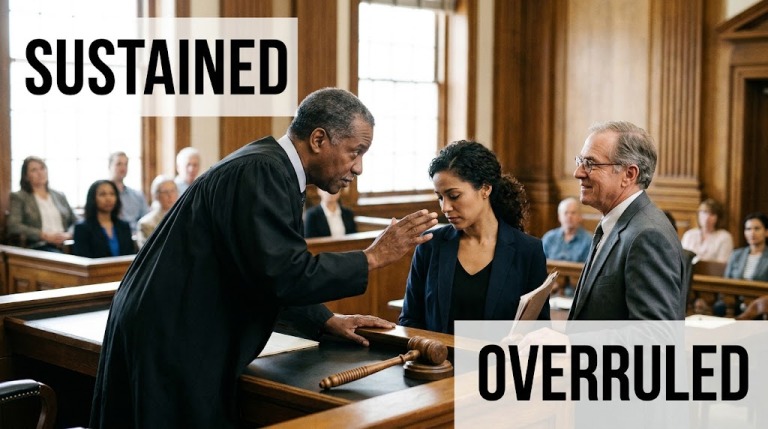
Sustained vs overruled is the first pair of courtroom words most people learn, and the one most people read slightly wrong. A lawyer says “objection,” the judge answers with one word, and the trial either keeps moving or hits a wall. Sustained means the judge agrees with the objection. Overruled means the judge doesn’t. What those two words set off, for the question, the witness, the jury and any later appeal, is what this guide unpacks.
MS. ALVAREZ: And what did the tow-truck driver tell you when he got there?
MR. BRENNER: Objection. Hearsay.
THE COURT: Sustained. Counsel, find another way to get at that.
MS. ALVAREZ: What did you see when you looked out the window?
MR. BRENNER: Objection. Relevance.
THE COURT: Overruled. The witness may answer.
THE WITNESS: A grey sedan, already in the intersection.
The short answer on sustained vs overruled
Sustained
The objection wins. The judge agrees the question, answer or exhibit breaks a rule. The witness doesn’t answer, or the exhibit stays out, and the lawyer has to rephrase, lay more groundwork, or move on.
Overruled
The objection loses. The judge sees no rule violation, or sees an exception that applies. The witness answers, the exhibit comes in, and the examination carries on as if nobody had spoken up.
That’s really all the vocabulary you need to follow a trial from the gallery. The rest of this article is about the texture around it: why judges rule the way they do, what a sustained objection can’t undo, why an overruled objection isn’t a verdict on the truth, and how the ruling ends up mattering long after the trial is over.
First, what an objection actually is
An objection is a lawyer’s way of saying, in the middle of a live proceeding, that something about a question or an exhibit breaks the rules of evidence or procedure. It isn’t an argument about who’s right in the case. It’s a request that the judge pause and decide whether this particular thing may be put in front of the fact-finder. In a jury trial that’s the jury. In a bench trial it’s the judge, which changes the atmosphere but not the mechanics.
Timing matters more than people expect. Objections come when the problem appears, which is why you’ll hear one fired off halfway through a question, before the witness has said a word. A lawyer who waits to see how the answer turns out risks losing the point entirely, something we’ll come back to in the section on appeals. Meanwhile the witness is supposed to stop talking the moment they hear the word and wait.
The judge then has real options, but two dominate: sustain or overrule. Everything else, like asking the lawyer to explain the basis, calling a sidebar, or taking the issue under advisement, is just a route to one of those two outcomes. That’s why sustained vs overruled is the pair that gets all the attention.
Sustained, explained: when the objection wins
“Sustained” comes from the older sense of the word, to uphold or hold up. When a judge sustains an objection, the judge is upholding the lawyer’s point. Whatever was challenged can’t go forward the way it was offered. If a question is pending, nobody answers it. If it’s an exhibit, it stays out of evidence. If the objection came after an answer, the answer is in trouble, and we’ll get to that.
Two flavors: form and substance
Not every sustained objection is a death sentence for the information. Many are about form. The question was compound, or it suggested its own answer, or it assumed something nobody had established. A judge who sustains an objection to form is basically saying, “Ask it properly.” The lawyer rewords the question and tries again, and often the same information comes in thirty seconds later.
Substance is different. If the objection is that the information itself can’t come in, for example because it’s an out-of-court statement offered for its truth with no exception available, rewording won’t fix anything. The lawyer needs a different route entirely: another witness, a different document, a foundation that brings in an exception, or acceptance that the point is lost.
Judges also split the difference. You’ll hear “sustained in part,” which usually means some of the testimony is fine and some isn’t, and the judge draws the line out loud.
What the lawyer does next
After a sustained objection, the examining lawyer typically has four moves. Rephrase the question. Build the missing foundation, such as showing the witness actually saw the event. Switch topics. Or, if the excluded testimony matters enough, ask to make an offer of proof, which is a way of telling the judge, outside the jury’s hearing, what the answer would have been. That last move protects the issue for appeal and is covered below.
What the jury takes from it
In the sustained vs overruled exchange, jurors usually see a sustained objection as a small stumble. Good judges say little beyond the word itself, though they may add “the jury will disregard the question.” Jurors are told, in one form or another, that the lawyers’ questions aren’t evidence and that they shouldn’t guess at what an unanswered question would have produced. Whether people manage that perfectly is a fair thing to wonder about, but that’s the instruction.
Overruled, explained: when the objection loses
On the overruled side of sustained vs overruled, the word means the judge has weighed the objection and set it aside. The question stands. The witness answers. The exhibit is received. Nothing about the ruling stops the other side from objecting again if the next question raises a fresh problem.
Judges overrule for a handful of recurring reasons. The rule really doesn’t apply to what was asked. An exception to the rule does apply, which is common with hearsay. The objection was too vague to identify a real problem. Or the objection was fine in theory but came too late. Sometimes the judge simply thinks the question is clear enough and the jury can handle it.
The softer versions
Not every overruling sounds like a slammed door. A judge might say “I’ll allow it,” which means the same thing in a friendlier register. Another common one is overruling “for now,” or subject to being connected up later. That’s a conditional ruling. The evidence comes in on the promise that the lawyer will tie it to something else shortly, and if that never happens, the opposing side can ask to have it struck.
What the objecting lawyer does next
A lawyer whose objection has just been overruled doesn’t argue the point with the judge in front of the jury. The usual options are to move on, to ask for a limiting instruction if the evidence is admissible for one purpose but not another, to question the witness briefly about foundation, or to ask for a standing objection so the same point doesn’t have to be repeated with every question in a line. The one thing a careful lawyer avoids is letting the ruling go unmarked when it matters, because a clean record is the only thing that keeps an appeal alive.
Sustained vs overruled side by side
If you want one place to look when the two words start blurring together, this table is it. It follows a single objection from the room to the record.
| Sustained | Overruled | |
|---|---|---|
| What the judge is saying | “You’re right. That isn’t allowed as asked.” | “I disagree. That’s allowed.” |
| The pending question | Not answered | Answered |
| A contested exhibit | Not admitted | Admitted into evidence |
| Who moves next | The questioning lawyer: rephrase, lay foundation, or drop it | The questioning lawyer continues; the objector may renew if the problem changes |
| The witness | Stays silent on that question | Answers, usually after the judge says “you may answer” |
| What jurors may hear | Possibly an instruction to disregard | The testimony or exhibit, with its full weight left to them |
| Appeal angle | Usually the questioning side’s issue, and only if it made an offer of proof | Usually the objecting side’s issue, if the objection was specific and preserved |
| Common misreading | “The lawyer who objected is winning the case” | “The judge believes the witness” |
The ten seconds after someone says “objection”
The whole thing happens quickly, but it follows an order. Here’s the sequence as it usually plays out in a jury trial.
- The objection. A lawyer stands and states it, ideally with a short ground: “Objection, hearsay.” Long speeches are discouraged, and many judges will cut them off.
- The freeze. The witness stops. If they’re mid-sentence, they stop mid-sentence. Nobody answers anything until the judge speaks.
- The quick look. The judge may rule instantly, ask the questioner for a response, or ask both lawyers to come to the bench. A sidebar keeps the argument out of the jury’s hearing.
- The ruling. The judge says sustained or overruled, sometimes adding a short instruction like “rephrase” or “you may answer.” The court reporter takes down all of it.
- The aftermath. Under a sustained ruling the lawyer reworks the question, moves on, or makes an offer of proof. Under an overruled ruling the witness answers and the examination continues. If the ruling matters, the lawyers make sure the record shows it.
Whichever way the sustained vs overruled call goes, that final step is easy to overlook from the gallery, but it’s the one that survives. The transcript is the only version of the trial an appeals court will ever see.
Why judges sustain: the objections you’ll hear most
A sustained objection is only as strong as the ground behind it. Most of what you’ll hear in an ordinary trial falls into a small family of objections. The table below puts each in plain language and gives a rough sense of how the sustained vs overruled call tends to go. These are tendencies, not guarantees. Judges differ, and the exact rule depends on the court.
| Objection | What it’s really saying | How it tends to go |
|---|---|---|
| Hearsay | The witness is repeating what someone else said outside court, to prove it’s true. | Often sustained, but exceptions are numerous, so overruled is common when the other side names one. |
| Relevance | The question doesn’t make any fact that matters more or less likely. | The bar is low, so judges overrule more often than they sustain. |
| Leading | The question suggests the answer the lawyer wants. | Usually sustained on direct examination, usually overruled on cross. |
| Lack of foundation | The witness hasn’t yet shown how they know this, or the exhibit hasn’t been authenticated. | Sustained until the basics are laid, then the same question is fine. |
| Speculation | The witness is guessing instead of reporting what they perceived. | Sustained when the answer would be a guess; overruled when the witness has a real basis. |
| Asked and answered | The lawyer already got this answer. | Depends on how much the judge wants to let a point be reinforced. |
| Argumentative | The question is a speech or a fight with the witness, not a question. | Frequently sustained, especially in cross-examination that has turned sharp. |
| Compound | Two questions are packed into one, so any answer is ambiguous. | Sustained as to form; fixed by splitting the question. |
| Calls for a narrative | The question is so open the witness can say anything. | Sustained when it invites a long ramble; overruled for simple background. |
| Beyond the scope | Cross-examination wandered outside what was covered on direct. | Judges often allow it anyway, or let the lawyer recall the witness later. |
| Unfair prejudice | The evidence has some value, but the risk of misleading or inflaming the jury outweighs it. | A judgment call, and one reviewed on appeal with a lot of deference to the trial judge. |
| Privilege | The answer would reveal a protected communication, such as one with a lawyer. | Sustained when the privilege is established and hasn’t been waived. |
A criminal trial leans on some of these harder than others. Hearsay and unfair prejudice come up constantly, and a good criminal defense lawyer treats every sustained or overruled ruling as part of a running record they may need later. In a civil case such as a crash claim, you’ll see the same objections, just in different clothes: foundation for medical records, hearsay in what a driver said at the scene, speculation about how fast a car was going.
When the answer slips out before the ruling
Witnesses are people, and people answer questions. Sometimes the answer is out before the lawyer finishes saying “objection.” That creates a problem the judge’s ruling alone can’t fix, because the jury has already heard it.
When that happens and the judge sustains the objection, the lawyer who objected usually has a ladder of remedies to climb, in this order:
- Motion to strike. The lawyer asks the judge to remove the answer from the record and treat it as though it was never given.
- Instruction to disregard. The judge tells the jury to ignore what they just heard. Courts rely on this constantly, and it’s the most common fix.
- Mistrial. If the damage is serious enough that no instruction could cure it, the lawyer asks the judge to end the trial and start over. Judges grant this rarely, and only when the prejudice is severe.
There’s a trap here that surprises people. In some courts, a sustained objection by itself doesn’t count as a loss the objector can complain about later, because they won the objection. If the harm lingers, the lawyer has to keep asking for more relief, an instruction first and then a mistrial, and make sure each request and each ruling lands on the record. Skipping steps can mean the issue is treated as given up.
What sustained and overruled do not mean
Because sustained vs overruled gets thrown around so much on television, a few wrong ideas have taken root. It’s worth clearing them out.
“A sustained objection means the lawyer is winning.”
It means the lawyer won one evidentiary point. A strong case can be full of overruled objections, and a weak one can feature a long run of sustained ones. The ruling is about whether something is allowed, not whether it’s persuasive or whether the claim behind it is any good.
“Overruled means the judge believes the witness.”
No. An overruled objection only tells you the testimony is allowed in. Whether it’s accurate, honest or convincing is up to the jury, or to the judge in a bench trial, and it gets decided later with everything else.
“The judge is taking sides.”
Judges are applying rules, and most rulings come down to routine rule application. A judge who sustains a run of objections from one side is usually responding to a run of questions that had problems. It’s easy to read bias into a pattern that is really about how the questions were built.
“A sustained objection erases the information.”
It doesn’t reach into jurors’ heads. It blocks the answer if it comes in time. If an answer or a suggestion has already landed, the remedies above reduce the harm but don’t guarantee it vanishes, which is one reason lawyers object early and on purpose.
“Once the judge rules, it’s final for the whole trial.”
Rulings can be revisited. If new facts show up, if a foundation gets built that wasn’t there before, or if the argument changes, a judge can reverse course. It’s rare, but it happens, and it’s especially common with conditional rulings.
Same words, other rooms
The sustained vs overruled language isn’t limited to witnesses and exhibits. It travels, and its meaning shifts a little depending on where you hear it.
Pleading challenges, like a demurrer
In courts that use demurrers, a party can challenge a complaint as legally deficient before any evidence is presented. If the court sustains the demurrer, it agrees the pleading has a problem and, in many courts, gives the plaintiff a chance to fix it by amending. If the court overrules the demurrer, the case proceeds on that pleading. Same two words, different stage of the case, and anyone in a civil dispute may run into them long before trial. A civil litigation lawyer can explain how those early rulings shape the rest of the case.
Written orders on motions
Some state courts still use “sustained” and “overruled” when ruling on written motions, not just spoken objections. A motion that’s sustained is granted, and one that’s overruled is denied. If you’re reading a docket entry and the vocabulary feels old-fashioned, that’s why.
Appeals courts overrule precedent, not objections
When a higher court says it is “overruling” an earlier decision, it’s doing something different. It’s declaring a prior case no longer good law. That has nothing to do with an objection at trial. If you see the word in a news story about a landmark case, it’s this second sense.
Hearings with no jury
Plenty of proceedings are decided by a judge alone: many family court matters, small-claims cases, and landlord-tenant disputes. Objections still get made, and rulings still get issued, though judges in these settings are often more relaxed about letting evidence in and sorting out its weight later. A person facing a hearing about an eviction or a divorce can still hear both rulings, just in a plainer, quicker setting.
Why the ruling matters on appeal
Most people never see this side of sustained vs overruled, but it’s where the ruling has its longest reach. An appeals court doesn’t retry the case. It reads the transcript. If a ruling isn’t clearly reflected there, as far as the appeals court is concerned, it never happened.
The three ingredients
To raise a ruling on appeal, a party generally needs a timely and specific objection, a ruling by the judge, and a record that shows both. Miss one and the issue may be treated as waived. That’s why lawyers keep objections short and pointed, name the rule behind them, and sometimes politely ask the judge to rule when the judge doesn’t.
Specific beats vague
An objection that just says “objection” without a ground can leave the judge guessing, and it can leave the appeals court unwilling to treat the point as preserved. The related rule is that the argument made on appeal should match the objection made at trial. A lawyer who objected on relevance can’t comfortably switch to hearsay on appeal.
Offers of proof
When a judge sustains an objection and the excluded information matters, the lawyer on the losing end of that ruling should make an offer of proof. It’s a short statement or a brief question-and-answer, usually outside the jury’s hearing, laying out what the testimony would have been. Without it, an appeals court has no way to tell whether keeping the evidence out actually hurt anyone.
How courts review these rulings
Appeals courts generally give trial judges a lot of room on evidence. The usual standard is abuse of discretion, which asks whether the ruling fell outside the range of reasonable choices. Even if a ruling was wrong, the error has to have mattered. Courts apply a harmless error test and let the result stand when the mistake probably didn’t change the outcome. There’s also a narrow exception for plain error, which can allow review of an obvious mistake that was never objected to, but it’s meant for rare and serious situations, not for fixing missed objections.
If you or someone you know is in the middle of a trial, don’t treat “sustained” or “overruled” as small talk between lawyers. Those rulings can become the basis of an appeal, and the lawyer’s attention to timing, wording and record-making is part of what you’re paying for.
Practical guidance for people who aren’t lawyers
You don’t have to know the rules of evidence to handle a courtroom well. You do need a few habits. Here’s how the two rulings play out for the people who are actually in the room.
If you’re a witness
- Stop talking the instant you hear “objection.”
- Wait for the judge. Don’t answer until you hear “overruled” or “you may answer.”
- If the judge says “sustained,” leave the question unanswered, even if you know the answer.
- If you’re confused about what’s happening, say so politely and wait.
If you’re a juror
- Don’t treat an unanswered question as proof of anything.
- Follow instructions to disregard something, even when it’s hard.
- Remember that an overruled objection only lets the evidence in; you still decide what it’s worth.
- Don’t hold objections against the lawyer who makes them.
If you’re representing yourself
- Learn the basic objections before your hearing, especially hearsay and foundation.
- State the ground in a few words and stop talking.
- When a ruling goes against you, say “thank you, Your Honor” and move on. Don’t argue with the judge in front of the jury.
- Ask for the ruling to be on the record if it matters.
If you’re just watching
- Don’t read a single ruling as a prediction of the verdict.
- Watch for the pattern: who is asking leading questions, who is wandering off topic.
- Notice the judge’s wording. “Rephrase” tells you it’s a form problem, not a substance problem.
- Remember that most of the action is routine rule application.
People handling a traffic matter or a small hearing without a lawyer often find this part reassuring. Most judges are patient with newcomers, and a traffic ticket lawyer can tell you whether your matter is likely to involve live testimony at all.
Phrases you might hear around a ruling
Judges don’t always stick to the two basic words. These variations all land inside the sustained vs overruled framework, and knowing them takes some of the mystery out of a live hearing.
| What the judge says | What it means in practice |
|---|---|
| “Sustained.” | The objection is upheld. The question or evidence is not allowed as offered. |
| “Overruled.” | The objection is rejected. The witness answers or the exhibit comes in. |
| “Sustained as to form.” | The idea may be fine, but the question was built wrong. Try again. |
| “Sustained, rephrase.” | Same as above, with a direct instruction to reword the question. |
| “I’ll allow it.” | Overruled in a friendlier voice. |
| “Overruled, subject to connection.” | Allowed for now, on the promise that the lawyer will tie it to something else. |
| “Sustained in part.” | Some of the testimony is allowed and some is not. |
| “The jury will disregard that.” | An answer was given that shouldn’t have been, and jurors are told to set it aside. |
| “The answer will be stricken.” | The answer is struck from consideration, though a copy of the words may remain in the transcript. |
| “I’ll reserve ruling.” | The judge will decide later, often after thinking it over or hearing more from the lawyers. |
Questions people ask about sustained vs overruled
What does sustained mean in court?
It means the judge agrees with the lawyer’s objection. The question, testimony or exhibit that was challenged isn’t allowed in the form it was offered. The examining lawyer can often reword the question, lay a better foundation, or move on.
What does overruled mean in court?
It means the judge disagrees with the objection. The witness may answer, or the exhibit may be admitted, and the examination continues. It doesn’t say anything about whether the evidence is true or persuasive.
Is sustained good or bad?
It depends on who you are in the room. A sustained objection helps the lawyer who objected and frustrates the one who asked the question. It tells you nothing about who will win the case, so it’s a mistake to read it as a scoreboard.
Can a judge change a ruling after saying sustained or overruled?
Yes. Evidentiary rulings during trial aren’t carved in stone. If new facts come out, a missing foundation gets built, or a fuller argument is made, a judge can revisit the ruling. It doesn’t happen often, but it isn’t unusual with conditional rulings.
What happens if the witness answers before the judge rules?
If the judge sustains the objection after the answer is out, the lawyer can ask to have it stricken and the jury told to disregard it. In serious cases, where no instruction could undo the damage, the lawyer may ask for a mistrial. Judges grant mistrials sparingly.
Does an overruled objection mean the evidence is true?
No. It only means the evidence can be considered. The jury, or the judge in a bench trial, still decides how much weight to give it, and the other side can attack it through cross-examination or contrary evidence.
Can you appeal an overruled objection?
Often, yes, but there are conditions. The objection generally has to be timely and specific, the judge has to have ruled on the record, and the error has to have affected the outcome of the case. An appeals court won’t reverse over a mistake that likely made no difference.
What’s the difference between sustained and overruled in a demurrer?
When a demurrer is sustained, the court finds the pleading legally deficient and often lets the party amend it. When it’s overruled, the case moves forward on that pleading. It’s the same pair of words applied to a written challenge instead of a spoken one.
Do witnesses ever object?
Not in the ordinary sense. Objecting is the lawyers’ job. A witness who thinks a question is improper can say they don’t understand it or ask for it to be repeated, but the formal objection comes from counsel, and the judge decides.
The bottom line on sustained vs overruled
Sustained vs overruled looks like a simple either-or, and at the surface it is. The judge agrees, or the judge doesn’t. But each word carries a cascade of consequences. A sustained ruling blocks a question, forces a rephrase, and sometimes sets up an offer of proof. An overruled ruling lets the evidence in, shifts the fight to cross-examination, and may become the centerpiece of an appeal. Neither tells you who’s winning. Both tell you how carefully a case is being tried.
If you’re heading into a hearing or a trial and the details matter, talking to someone who handles these moments for a living is worth the time. You can browse our directory of criminal defense lawyers or look through civil litigation lawyers to find someone who fits your situation. And if you were hurt in a crash and a trial is looming, our guide to car accident lawyers explains what the road ahead tends to look like.
This article is general legal information, not legal advice. Evidence rules and courtroom practice vary by court, judge and type of case, and nothing here creates a lawyer-client relationship. For guidance on a specific matter, speak with a licensed attorney.