Legal insight
Scout Oath and Law: The Words, the Meaning, and How Scouts Live Them
Scout Oath and Law Guide Scouting values guide Scout Oath and Law: The Words, the Meaning, and How Scouts Live Them The Scout Oath and Law take less than a minute to say out loud, and most Scouts can recite…
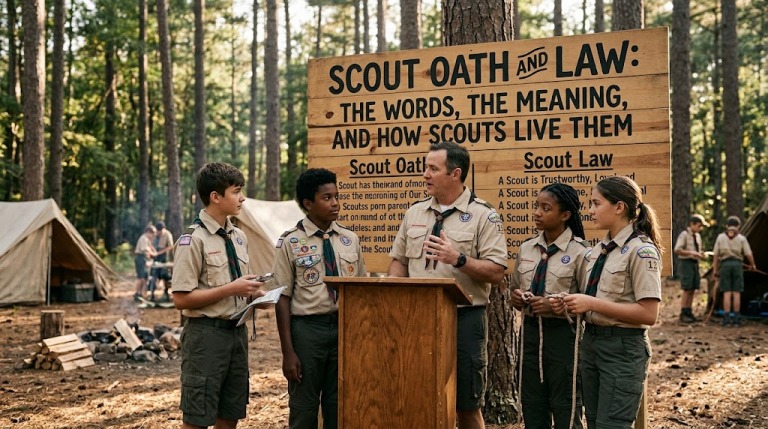
Scout Oath and Law: The Words, the Meaning, and How Scouts Live Them
The Scout Oath and Law take less than a minute to say out loud, and most Scouts can recite them by the end of their first month. Understanding them takes far longer. This guide gives you the exact wording, explains every line and every one of the twelve points in plain language, traces where the words came from, and shows what living by them looks like for a nine-year-old, a teenager heading toward Eagle, and an adult volunteer.
The Scout Oath
On my honor I will do my best to do my duty to God and my country and to obey the Scout Law; to help other people at all times; to keep myself physically strong, mentally awake, and morally straight.
The Scout Law
A Scout is trustworthy, loyal, helpful, friendly, courteous, kind, obedient, cheerful, thrifty, brave, clean, and reverent.
What the Scout Oath and Law actually are
Ask a longtime Scouter what the program is about and you will hear about camping, knots, and campfires. Ask what the program is for and the answer almost always circles back to two short texts. The Scout Oath and Law are the written core of Scouting, the thing every activity is meant to serve. The organization, called the Boy Scouts of America until it adopted the name Scouting America in 2025, describes its mission as preparing young people to make ethical choices across their lives by instilling the values found in the Oath and Law. The hiking, the cooking over a fire, and the service projects are how those values get practiced.
It helps to think of the Scout Oath and Law as a pair that does two different jobs. The Oath is a promise, spoken in the first person, that a young person makes of their own free will. The Law is a description of the person that promise is aiming at, written as twelve short character traits. You cannot really understand one without the other, because the Oath ends by pointing straight at the Law: a Scout promises “to obey the Scout Law.” Everything else in the Oath is a commitment about how that effort will show up in the world.
The official Scouting America site gives its own short explanation if you want the organization’s wording alongside this guide: What are the Scout Oath and Scout Law?
Scout Oath vs. Scout Law: how they differ
New parents mix up the two halves of the Scout Oath and Law all the time, and so do plenty of new Scouts. The simplest way to separate them is to ask what each one does. The table below puts them next to each other.
| Question | Scout Oath | Scout Law |
|---|---|---|
| What is it? | A personal promise a Scout makes | A list of twelve qualities a Scout works toward |
| Form | One sentence with three commitments | One sentence with twelve traits |
| Voice | “I will…” (a vow) | “A Scout is…” (a standard) |
| Main question it answers | What am I willing to commit to? | What kind of person am I trying to be? |
| How it is used | Recited at meetings and ceremonies, and tied to joining | Used as a yardstick in advancement and everyday decisions |
| Link between them | Includes the promise to obey the Law | Gives the Oath its detail |
If the Oath is the signature on the page, the Law is the character the signature stands for. A Scout can slip up on a given Tuesday and still be keeping the Oath, because the promise is to do one’s best, not to be flawless. The Law gives that effort a direction.
Where the Scout Oath and Law came from
The history of the Scout Oath and Law is short enough to tell in a few lines. The ideas did not appear overnight. They grew out of the first decade of the twentieth century, when two writers on opposite sides of the Atlantic were publishing outdoor and character-building ideas for boys at almost the same time.
- 1908Robert Baden-Powell publishes Scouting for Boys in England. It includes the first Scout Law, a list of nine points that opens with the idea that a Scout’s honor is to be trusted.
- 1910The Boy Scouts of America is founded. Its first Scout Law follows the original British nine points almost exactly.
- 1911The American Scout Law grows to twelve points with the addition of brave, clean, and reverent. That list is the one Scouts recite today.
- 2019The older-youth program, renamed Scouts BSA, opens to girls, and the same Oath and Law apply to every member.
- 2025The organization takes the name Scouting America. The Oath and Law stay as they were.
Historians also point to Ernest Thompson Seton, an early American Scouting leader whose woodcraft writing ran in parallel with Baden-Powell’s. His own lists of virtues look very close to the twelve American points, which suggests the American version came out of a shared pool of ideas about outdoor character rather than from one author alone. What matters for modern readers is how stable the text has been. The wording a Scout learns today would be recognizable to a Scout from over a century ago.
The Scout Oath, line by line
The first half of the Scout Oath and Law is a single sentence, and each clause of it carries its own weight. Taking it apart makes it easier to talk about with a child and easier to remember.
“On my honor I will do my best”
The opening phrase puts a person’s reputation behind what follows. Honor here means that the Scout is staking their word, which is why the phrase has always been treated seriously. The second half, “I will do my best,” is the part that surprises people. It does not demand perfect results. It promises honest effort, and that is something a ten-year-old can truthfully promise.
“To do my duty to God and my country”
Duty is the word to focus on. A duty is something owed, whether or not it is convenient. The Oath names two: a duty to God, which Scouting understands broadly enough to include many faiths, and a duty to one’s country, which in practice means being a responsible citizen who votes later in life, follows laws, and takes part in a community.
“And to obey the Scout Law”
This clause is the hinge. It connects the promise to the twelve points, so that the Oath never floats free as a slogan. A Scout who forgets what the Law says has nothing concrete to obey, which is why the two are always taught together.
“To help other people at all times”
The phrase “at all times” is deliberate. Helping when a troop is watching is easy. The Oath asks for help when nobody is checking, such as carrying a neighbor’s groceries or staying after a campout to finish the dishes without being asked. It is the root of the Scouting slogan about doing a good turn daily.
“To keep myself physically strong, mentally awake, and morally straight”
The final clause turns inward and covers the whole person in three parts. Physically strong means looking after the body through exercise, sleep, and sensible choices. Mentally awake means staying curious, paying attention, and learning. Morally straight means choosing right over easy, even in small private moments.
A small detail worth knowing: In the Scout sign, three fingers are raised. They stand for the three parts of the Oath: duty to God and country, helping other people, and taking care of oneself. When Scouts hold up that sign while reciting, the hand itself is a memory aid.
The twelve points of the Scout Law, explained
The Law is traditionally taught in a fixed order, and the rhythm of that order is what makes it easy to remember. Each point below includes a plain-language explanation and a quick example of what it can look like in an ordinary week. These explanations are written in everyday language, so you can use them when a young Scout asks “but what does that really mean?”
- 1
Trustworthy
People can rely on what you say and what you do. A trustworthy Scout tells the truth even when the truth is inconvenient, and keeps promises, including the small ones.
Try: Admit you broke the borrowed tent pole before anyone asks.
- 2
Loyal
Loyalty means standing by your family, friends, troop, school, and country. It also means speaking well of people when they are not in the room.
Try: Defend a patrol mate who is being teased.
- 3
Helpful
A helpful Scout notices a need and acts without waiting for a reward. The best help is usually the kind nobody asked for out loud.
Try: Shovel a neighbor’s walk before they wake up.
- 4
Friendly
Friendliness is openness toward everyone, including people who are different from you or new to the group. It is the opposite of cliques.
Try: Sit with the new kid at the next meeting.
- 5
Courteous
Courtesy is good manners that come from respect, not performance. It shows up in how you speak to a server, a teacher, a little sibling, or a stranger on the trail.
Try: Say thank you to the bus driver, every time.
- 6
Kind
Kindness means caring about the feelings of people and animals, and refusing to cause pain without a good reason. It takes more effort than being polite.
Try: Stop a joke that has started to hurt someone.
- 7
Obedient
An obedient Scout follows the rules of home, school, and troop, and obeys the laws of the community. If a rule seems wrong, the Scout works to change it by proper means instead of ignoring it.
Try: Wear the seat belt and speak up if a friend will not.
- 8
Cheerful
Cheerfulness is choosing a good attitude when things are tiring or wet or boring. Nobody expects constant smiles. They expect effort to keep the mood from sinking.
Try: Keep going on the rainy hike and keep the others going too.
- 9
Thrifty
Thrift is using money, time, and gear wisely. It means working to earn what you need, saving some, and not wasting what you have been given.
Try: Repair the backpack zipper instead of replacing the pack.
- 10
Brave
Bravery is facing fear, danger, or criticism and doing the right thing anyway. It also covers the quiet courage of saying no when the group is going the wrong way.
Try: Tell an adult when a friend is being bullied.
- 11
Clean
A clean Scout keeps body, speech, and surroundings clean. That reaches past hygiene to the language you use and the places you leave behind.
Try: Pack out every scrap of trash from the campsite.
- 12
Reverent
Reverence means respect for God and for the beliefs of other people. Scouting welcomes members of many faiths, and a reverent Scout is faithful to their own religion while respecting everyone else’s.
Try: Stay quiet and respectful during another troop’s service.
Taken together, these twelve points describe someone you would be glad to have on your team, your street, or your camping trip. They also overlap. A brave act is often also a kind one, and being trustworthy is usually what makes someone loyal in a way that counts. Scouts learn the Law as a list, but they live it as a single character.
The Scout motto, slogan, and Outdoor Code
The Scout Oath and Law do not stand alone, and the pair is rarely taught without help. Three short companions are taught with them, and together they cover most of what a Scout is expected to carry in their head.
Motto
Be Prepared. Baden-Powell explained it as always being ready, in mind and body, to do your duty. It connects directly to the Oath’s promise of duty.
Slogan
Do a good turn daily. A good turn is a small act of help done quietly. It turns the Oath’s phrase “at all times” into a daily habit.
Outdoor Code
A promise to be clean in outdoor manners, careful with fire, considerate of others outside, and conservation-minded. It applies the Law’s idea of cleanliness to nature.
If you are helping a child who is nervous about memorizing, the order of difficulty is usually the Oath, then the Law, then the motto and slogan. The motto and slogan are short enough that most Scouts have them within a meeting or two.
How the Scout Oath and Law show up across the ranks
Scouting is built as a ladder, and the Oath and Law are on every rung. They change in how they are taught, not in what they say.
| Stage | How the Oath and Law are used |
|---|---|
| Cub Scouts | Younger members learn the same Scout Oath and Law in kid-sized language, with games, posters, and den discussions. Current Cub Scout programs use them in place of the older Promise and Law of the Pack. |
| Scouts BSA, first rank | A new Scout learns to recite the Oath, Law, motto, and slogan and to explain what they mean in their own words. Reciting is expected. Explaining is where the learning happens. |
| Middle ranks | Leaders look for “Scout spirit,” which means a Scout is trying to live by the Oath and Law at home, at school, and in the troop, not just at meetings. |
| Eagle and leadership | Older Scouts lead younger ones and are expected to model the Law. Many Eagle Scouts describe the points as a checklist they still use as adults. |
| Adult volunteers | Leaders repeat the Oath and Law at their own training and in the troop, and they are the example the youth watch most closely. |
One thing the ranks make clear is that the Scout Oath and Law are practiced, not just remembered. A Scout who knows the Scout Oath and Law by heart but ignores them on the playground has missed the lesson. A Scout who recites perfectly but treats others badly has missed the point, and any decent troop leader will say so.
How to learn the Scout Oath and Law (and help a child learn them)
Memorizing is the easy half. The harder half is getting a young person to care about the words. These approaches work well for both.
- Chunk the Oath into five beats. Honor and best effort, duty, the Law, helping, and the three-part self-care clause. Learn one beat per day.
- Use the fingers. Raise the Scout sign as you say the three promises. The motion pairs with the words and sticks.
- Learn the Law in groups of four. Trustworthy through friendly, courteous through cheerful, thrifty through reverent. Four items at a time is manageable.
- Make each point personal. Ask the Scout for a real moment from the week that fits a given point. A short story beats a definition.
- Recite at a regular time. Before dinner or at bedtime works well. Repetition in a calm moment does more than cramming.
- Turn it into a game. Cards, puzzles, and “which point is this?” scenarios keep younger kids engaged.
Parents sometimes worry that rote recitation will feel empty. It can, if it stops there. The fix is conversation. After a tough moment at school, ask which of the twelve points was in play. A question like that lets a child practice the Scout Oath and Law without feeling lectured.
Living the Scout Oath and Law at school, at work, and online
People who left Scouting decades ago can often still recite the Scout Oath and Law, or at least name the Law, and many say they never stopped using it. Here is how the points translate once the uniform is off.
At school. Trustworthy means doing your own work. Helpful means sharing notes with a classmate who was out sick. Courteous means listening to the teacher and to the student who disagrees with you. In group projects, loyalty is showing up on time so the others are not left carrying your part.
At work. The Law maps neatly onto what employers say they want. Reliability, honesty, teamwork, a good attitude, and care with company resources are all in the twelve points. Thrifty becomes careful stewardship of a budget. Brave becomes raising a safety concern when it would be easier to stay quiet.
Online. Digital life is where kindness and courtesy get tested hardest. Before posting, a Scout might ask whether it is true, whether it is kind, and whether they would say it to the person’s face. Obedient also applies, since following a platform’s rules and the law is part of being a good digital citizen.
In the family. Cheerful chores, kind words to a brother or sister, and helping without being asked at home are where the Oath’s “at all times” gets real. Families who talk about the Scout Oath and Law at the dinner table tend to find the vocabulary useful for settling arguments, because the points give everyone a shared language for fairness.
For adult leaders and parents: values, safety, and the law
Adults are asked to hold themselves to the same Scout Oath and Law as the youth, and young Scouts notice when the adults do not. A leader who talks about trustworthiness and then cuts corners on paperwork or safety rules teaches the opposite lesson. That is why youth protection training, two-deep adult supervision on outings, and careful trip planning are treated as part of living the Law, not as red tape. Being obedient, brave, and helpful on behalf of kids includes following the safeguarding rules that keep them safe.
The Law also connects to ordinary legal responsibilities. The “obedient” point extends to obeying the laws of the community, and older Scouts who start driving to meetings or outings take on traffic rules and their consequences. If a teenager does get a citation, a plain-language overview of how a traffic ticket lawyer can help shows what the process looks like and when professional advice is worth considering.
Troops also meet the real world at campsites, community halls, and borrowed facilities. When a hazard on someone else’s property causes an injury, the question of responsibility is usually a matter of premises liability, and a broader overview of the topic is available in our personal injury legal guide. We mention this not to worry anyone, since the vast majority of Scouting outings are safe and well run, but because informed adults make better decisions. If you are looking for other background articles, our legal guides library is a good starting point.
This section offers general information and is not legal advice. Laws differ from place to place and every situation has its own facts. For a specific problem, speak with a licensed attorney.
Common mix-ups about the Scout Oath and Law
“The Law is just a list of rules.” It is closer to a portrait. Rules tell you what to avoid. The twelve points describe a person worth becoming, which is why Scouts are asked to explain them in their own words.
“Reverent means you must follow one religion.” The point asks for faithfulness to your own beliefs and respect for others’. Scouting has long welcomed members from many faith traditions under this idea.
“Thrifty means cheap.” A thrifty Scout can be very generous. The point is about using resources wisely and not wasting them, and generosity is one way of using resources well.
“Doing my best means I can’t fail.” The Oath expects effort, not perfection. Scouts who fall short are encouraged to try again, which is itself an example of the Law’s bravery and cheerfulness.
“It only matters at meetings.” The wording “at all times” in the Oath is the answer. The values are meant to travel with a Scout everywhere.
“Morally straight is old-fashioned.” The phrase is old, but the idea is plain: choose the right thing when it costs you something. Most people would still call that a good rule for living.
The Scout Law and Promise around the world
Scouting spread across the globe within a few years of its start, so the Scout Oath and Law have relatives in almost every country. Most national organizations have their own wording of a Scout Promise and Law. The wording has changed over time and differs from country to country, but the heart of it is shared: honor, duty, service to others, and a commitment to personal character. The American Scout Law, with its twelve points, is one national version of that shared tradition. It has remained notably consistent since 1911, even as the organization itself has grown and changed its name and membership.
If you are comparing the American text with another country’s version, expect to see differences in the number of points, in how duty to God is phrased, and in how loyalty is described. Those differences reflect local culture and history. They do not change the basic idea that a Scout’s word can be trusted.
Scout Oath and Law: frequently asked questions
What is the Scout Oath and Law?
It is the pair of statements at the center of Scouting. The Scout Oath is a three-part promise about duty, helping others, and self-care. The Scout Law is a twelve-point description of a Scout’s character.
How many points are in the Scout Oath and Law?
There are twelve: trustworthy, loyal, helpful, friendly, courteous, kind, obedient, cheerful, thrifty, brave, clean, and reverent.
Who wrote the Scout Oath and Law?
Robert Baden-Powell published the first Scout Law in 1908, and the American version was adapted from it when the Boy Scouts of America formed in 1910 and added three points in 1911. Other early Scouting writers helped shape the American text.
Do Cub Scouts recite the Scout Oath and Law?
Yes. Current Cub Scout programs use the same Oath and Law, taught in simpler language, in place of the older Cub Scout Promise and Law of the Pack.
What does “morally straight” mean?
It means choosing what is right and honest, even when no one is watching and the wrong choice would be easier. Along with physically strong and mentally awake, it completes the Oath’s picture of a whole person.
Is the Scout Oath religious?
The Oath mentions duty to God, and the Law includes reverent. Scouting understands these broadly and welcomes members of many faiths, asking each to be faithful to their own beliefs and respectful of others’.
What is the difference between the Scout Oath and the Scout Law?
The Oath is the promise a Scout makes. The Law is the standard of character the Scout is promising to follow. The Oath itself includes a pledge to obey the Law, which ties them together.
What is the easiest way to memorize the Scout Oath and Law?
Break the Oath into short beats, learn the Law four points at a time, say them at a regular time each day, and connect each point to a real moment from the week.
Can adults follow the Scout Oath and Law?
Absolutely. The Scout Oath and Law are not age-limited. Adult leaders recite them with the youth, and many former Scouts continue to use the twelve points as a personal guide long after leaving the program.
Final thoughts
The Scout Oath and Law are short on purpose. They were meant to be remembered on a muddy trail, in a crowded meeting hall, or at a kitchen table when a hard choice shows up. A young person who learns the words has a start. A young person who learns to ask which of the twelve points applies to the situation in front of them has something that lasts. Whether you are a parent, a leader, or a former Scout thinking back, the best way to honor the Scout Oath and Law is the one the Oath itself describes: do your best, help others, and try again tomorrow.