Legal insight
Military Divorce Attorney: Retirement Benefits, Child Custody, and Legal Rights
A military divorce is still handled in a state court, but military service can affect where the case may be filed, when it can move forward, how retired pay is divided, and how parenting schedules are built. The first useful…
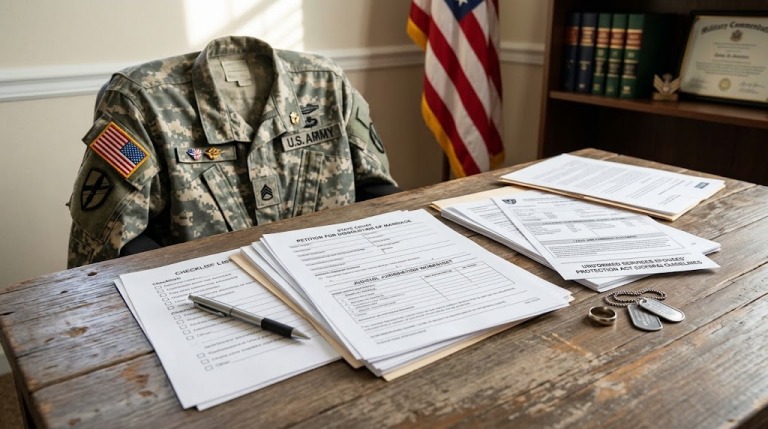
A military divorce is still handled in a state court, but military service can affect where the case may be filed, when it can move forward, how retired pay is divided, and how parenting schedules are built. The first useful question is not simply, “Do I need a military divorce attorney?” It is: which state has authority over the marriage, the children, and any military retirement at issue?
This guide organizes the documents and decisions that commonly matter when one or both spouses serve or previously served. It is general legal information, not a prediction about a particular case.
Start with three separate legal maps
Military families often have more than one plausible connection: a duty station, a legal residence, a spouse’s residence, a home of record, or a child’s home state. Those facts do not always answer every issue in the same way. It helps to separate:
- Divorce jurisdiction: the state court that can dissolve the marriage.
- Child-custody jurisdiction: usually analyzed under the child’s residence history and applicable state law.
- Military retirement jurisdiction: a separate federal-law question when a court is asked to divide retired pay.
Before filing, make a timeline of every state where either spouse lived during the marriage, the dates of each assignment, and where each child lived during the previous five years. A lawyer can then test the available forums instead of relying on the mailing address shown on a current order.
Active service can affect timing and default proceedings
The Servicemembers Civil Relief Act may protect a qualifying servicemember whose duties materially affect the ability to participate in a civil case. Courts also have duties before entering certain default judgments. These protections do not erase a divorce case or permanently prevent orders. They are designed to preserve a fair opportunity to appear and respond.
Keep deployment orders, training schedules, command contact information, leave availability, and proof of when court papers were received. A request based on military duties should be handled through the court process; ignoring documents can create avoidable problems.
Military retired pay is not divided automatically
The Uniformed Services Former Spouses’ Protection Act allows state courts to treat qualifying disposable retired pay according to state domestic-relations law. It does not automatically award a former spouse a percentage. A valid state-court order is required, and the wording used in that order matters.
The familiar “10/10 rule” is frequently misunderstood. It generally concerns whether the Defense Finance and Accounting Service can make direct payments when at least ten years of marriage overlap ten years of creditable service. It is not, by itself, a universal rule deciding whether a state court may divide military retirement.
Gather the marriage certificate, service dates, retirement or reserve point statements, current pay information, and any estimate of retired pay. If disability benefits, a medical retirement, or an election affecting retired pay is involved, flag that issue early because the federal treatment can be specialized.
Survivor protection requires its own decision
A division of retired pay does not necessarily preserve payments after the servicemember’s death. Survivor Benefit Plan coverage is a separate subject with election rules, costs, deadlines, and order language. The parties should understand who will be the beneficiary, which base amount will apply, who bears the premium, and which filing must be made.
Do not assume that a divorce decree alone completes every benefit election. Ask for written confirmation of any required submission and retain proof of delivery.
Health care, housing, and other benefits should be verified
Eligibility for post-divorce military benefits can depend on the length of the marriage, length of service, overlap between them, remarriage, and the particular benefit program. Rules commonly described with shorthand such as “20/20/20” should be checked against current official guidance and the family’s exact dates.
Create a transition list covering health coverage, identification cards, housing, moving expenses, life insurance, beneficiary designations, and access to accounts. Some items are controlled by federal rules rather than whatever the spouses privately agree.
Build a parenting plan around real military demands
A useful military parenting plan anticipates more than ordinary weekends. It may address deployments, temporary duty, unpredictable reporting times, long-distance transportation, virtual contact, make-up parenting time, access to school and medical records, and notice of new orders.
It should also explain what happens when a parent leaves and returns. A temporary delegation to a stepparent or family member is not automatically the same as a permanent custody change. State law controls, so the order should use precise language and avoid treating deployment as parental misconduct.
For a broader custody preparation checklist, review the child custody lawyer guide. The divorce lawyer guide explains the larger filing and property process, while the family law topic page helps identify related support and property questions.
Support calculations need complete pay records
Military compensation can include basic pay, allowances, special pays, bonuses, and benefits that appear differently from civilian wages. A state court decides what counts as income under its law. Bring several Leave and Earnings Statements rather than a single month, recent tax returns, housing information, child-care costs, insurance premiums, and documentation of recurring special pay.
Documents to organize before contacting a lawyer
- Marriage certificate, prior orders, agreements, and pending court papers.
- Orders showing duty station, deployment, or permanent-change-of-station dates.
- Each spouse’s residence and domicile history.
- Children’s five-year address and caregiver history.
- Leave and Earnings Statements, tax returns, account statements, and debt records.
- Retirement statements, reserve points, and benefit elections.
- A proposed parenting calendar that works during ordinary duty and absence.
Questions to ask a military divorce attorney
- Which state can decide the divorce, custody, and retirement issues, and why?
- Does the SCRA affect the current deadline or hearing?
- How should the order describe retired-pay division and survivor coverage?
- Which military benefits require separate forms or notices?
- How will deployment and relocation be handled in the parenting plan?
- What records are needed to calculate income and support accurately?
Frequently asked questions
Must a military divorce be filed at the current duty station?
No single answer applies. Filing options can depend on state residency rules, domicile, the spouse’s location, the children’s home state, and the relief requested.
Does ten years of marriage guarantee half of military retirement?
No. The ten-year overlap rule is commonly relevant to direct DFAS payment. Division and percentage are determined through applicable state law and the court order.
Can deployment cause a parent to lose custody?
Deployment can require temporary arrangements, but state and federal protections may restrict treating military absence as the sole basis for a permanent adverse change. The exact rule must be checked locally.
Official references: Read the Department of Justice SCRA rights guide and the DFAS USFSPA legal overview.
AskLocalLaw provides general legal information and lawyer-discovery tools. This article is not legal advice and does not create an attorney-client relationship. Family-law and military-benefit rules should be verified for the relevant state and current service status.