Legal insight
Is Lane Splitting Legal in Texas?
On this page The short answer What the statute says Splitting, filtering, sharing Situations riders ask about Tickets and penalties Lane splitting and crash claims How Texas got here Both sides of the debate Other states Riding smart without splitting…
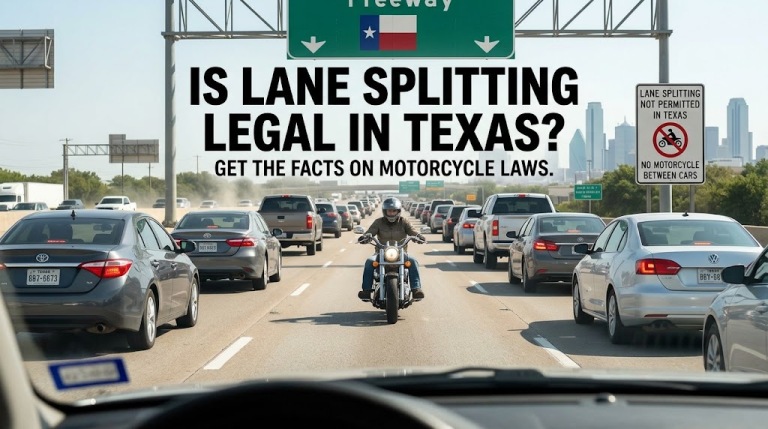
Is Lane Splitting Legal in Texas?
No. Is lane splitting legal in Texas is one of the most searched motorcycle questions in the state, and the answer has been settled since September 1, 2023, when a short new section of the Transportation Code made the ban explicit. If you ride between two lanes of traffic that are moving the same direction, you are breaking Texas law, no matter how slowly everyone else is crawling.
- Riding between lanes of same-direction traffic is prohibited by Transportation Code § 545.0605.
- Passing a vehicle while sharing its lane is prohibited too, which covers most lane filtering.
- Two motorcycles riding side by side in one lane is still allowed.
- The only listed exception is a police officer on duty.
Is lane splitting legal in Texas? What the statute actually says
For years, the honest answer to “is lane splitting legal in Texas” was a shrug with a footnote. No statute used the words. Officers wrote tickets under the general lane rule in Section 545.060, which tells every driver to stay as nearly as practical within a single lane and not to leave it until the move can be made safely. A lawyer could argue that a motorcycle straddling a lane line was still “as nearly as practical” inside a lane. Some did, with mixed results.
That wiggle room closed with House Bill 4122, written by Representative Ryan Guillen. It passed the House 124 to 10, passed the Senate 30 to 0, and took effect on September 1, 2023. It added a brand-new section, 545.0605, titled Operation of Motorcycles on Roadway Laned for Traffic. Here is the working part of the enrolled text:
(a) The operator of a motorcycle:
(1) is entitled to full use of a lane and … a motor vehicle may not be driven in a manner that deprives a motorcycle of the full use of a lane;
(2) may operate the motorcycle two abreast in a single lane with another motorcycle; and
(3) may not: (A) operate the motorcycle more than two abreast in a single lane with other motorcycles; (B) operate the motorcycle between lanes of traffic moving in the same direction; or (C) pass a motor vehicle while in the same lane as the vehicle being passed.
(b) Subsection (a)(3) does not apply to a police officer in the performance of the officer’s official duties.
Read it slowly, because it does two jobs at once. Paragraph (3)(B) is the classic ban on Texas motorcycle lane splitting: no riding in the seam between two lanes. Paragraph (3)(C) is broader than most riders expect. It bans passing a car while you are still inside the same lane as that car, which is exactly what a rider does when they slide up the gap beside a stopped sedan at a red light. Between them, the two clauses cover both the freeway version and the intersection version of the maneuver. You can read the full enrolled bill yourself, and the current chapter sits in the Texas Transportation Code, Chapter 545.
Notice also what the section gives riders. Paragraph (a)(1) says a motorcycle is entitled to the full use of a lane and that other vehicles cannot be driven in a way that takes it away. Lawmakers paired a restriction with a protection. If a driver squeezes a rider onto the line or shoulders in beside them, that driver is not off the hook just because the rider is not allowed to split lanes.
Lane splitting, lane filtering and lane sharing are not the same thing
People use these words loosely, and the loose use causes real confusion when someone is deciding whether a particular move will earn a ticket. Here is how they differ, and where Texas lands on each.
| Practice | What the rider does | Texas status |
|---|---|---|
| Lane splitting | Rides between two lanes of traffic moving in the same direction, usually along the painted line, often at highway speeds in congestion. | Prohibited |
| Lane filtering | Moves between stopped or crawling vehicles, typically to reach the front of the line at a light. | Prohibited (no general exception for civilians) |
| Lane sharing | Two motorcycles ride side by side inside one lane. | Allowed (but never three abreast) |
| Passing inside your lane | Overtakes a car while both occupy the same lane. | Prohibited |
| Officer on duty | A police officer riding between vehicles while performing official duties. | Exempt |
The line between splitting and filtering matters in other states because filtering at low speed is the version legislators find easiest to accept. In Texas, the distinction has no legal effect. Whether the traffic around you is doing 60 or sitting at a dead stop, the statute asks one question: are you between lanes, or passing a vehicle inside its own lane? If yes, it is a violation. So when someone asks whether lane filtering is legal in Texas, the answer is the same as for lane splitting.
Real situations riders ask about
The statute reads cleanly on paper. Traffic does not. Before a rider decides whether lane splitting is legal in Texas for their own situation, it helps to see the scenarios that come up most often and how the Texas lane splitting law treats each one.
Rolling up to the front at a red light
This is lane filtering, and it is the one most riders consider harmless. It still falls under paragraph (3)(C), since you pass a stopped vehicle while sharing its lane. Texas has no stopped-traffic exception for civilians, so an officer who sees it can cite it.
Crawling freeway traffic on a hot afternoon
Stop-and-go on I-35 or the 610 Loop feels like the textbook case for splitting. It is also the case lawmakers had in mind when they wrote the ban. Slow speeds do not change the answer to whether lane splitting is legal in Texas.
Using the shoulder to get around a jam
Section 545.058 lets any driver use an improved shoulder only in narrow situations, such as passing a vehicle that is slowing or stopped to turn, and only when it can be done safely. Treating the shoulder as a bypass lane for the whole backup does not fit. Riders who do it invite a separate citation.
Riding with a friend, side by side
Fine, as long as there are only two of you and both stay inside the same lane. A third bike makes it illegal, and so does one rider pulling ahead by squeezing past another inside the lane.
An officer on a police motorcycle
Subsection (b) exempts a police officer performing official duties. A private rider cannot borrow that exemption, even a retired officer or a rider with an emergency of their own.
Passing a car on a two-lane road
Ordinary passing is a different matter. A rider who changes lanes to overtake, using the full opposing lane where it is legal and safe, is following the usual passing rules and is not lane splitting.
What happens if you get pulled over for lane splitting
Section 545.0605 does not carry its own penalty schedule. A violation is handled like most other traffic offenses in Texas, which are misdemeanors covered by a general penalty provision that caps the fine for an ordinary moving violation at $200. Add court costs and fees, and the amount that actually leaves your wallet varies by county and by court. Attorney summaries published around the state tend to quote totals somewhere between roughly $175 and $300 or more, and that is the realistic planning range. Your local court sets the number, not a statewide chart.
The fine is rarely the expensive part. A conviction for a moving violation can go on your driving record, and many insurers treat any motorcycle citation as a reason to reprice. That can mean higher premiums for years. Some courts allow eligible drivers to take a driver safety course or accept deferred disposition to keep a ticket off the record, but eligibility rules and timing depend on the court, so check with the clerk or talk to a local traffic ticket lawyer before you decide how to respond.
When it turns into something worse
An officer has discretion. If the way someone was splitting lanes looked dangerous, such as weaving at high speed through a packed freeway, the stop can end with a reckless driving charge instead of a simple lane violation. Reckless driving in Texas is a separate offense and can carry up to 30 days in jail along with a fine, and a rider facing that charge should speak with a criminal defense lawyer rather than handle it alone. Splitting lanes during a police pursuit, while intoxicated, or right before a crash raises the stakes further.
How lane splitting affects an injury claim after a crash
This is the part most riders do not think about until it is too late. A ticket costs a few hundred dollars. A crash during an illegal maneuver can change who pays for medical care, lost wages and a totaled bike.
Texas follows a proportionate responsibility rule. Under Chapter 33 of the Civil Practice and Remedies Code, a jury assigns each party a percentage of fault. If you are found more than 50 percent responsible, you recover nothing. If you are at 50 percent or less, your compensation is reduced by your share. Picture a rider with $100,000 in damages who is found 30 percent at fault. The most that rider could collect is $70,000. Raise that to 51 percent and the number drops to zero.
Lane splitting hands the other side an easy opening argument. The insurer’s adjuster does not need to prove much: the rider was somewhere the law says a motorcycle cannot be. Violating a traffic statute can be used as evidence of negligence, and a rider who was splitting may start the negotiation already assigned a chunk of blame.
Illegal does not mean you lose.
Being a lane splitter does not erase the other driver’s duties. A driver who changes lanes without checking mirrors, opens a door into traffic, drifts over the line while texting, or deliberately crowds a rider can still be found mostly or entirely responsible. The question a jury weighs is what caused the collision, not only what the rider was doing wrong.
What insurers and defense lawyers look for
- The rider’s speed compared with surrounding traffic.
- Whether the rider was between lanes or simply near the line.
- Whether the other driver signaled, and how long before moving over.
- Camera footage, dashcam video and witness statements.
- Phone records, if the other driver may have been distracted.
- What the police report says about the maneuver.
If you were hurt, evidence is time-sensitive. Business cameras overwrite footage within days, and a driver’s memory gets tidier every week. Texas also gives most injury plaintiffs two years from the date of the crash to file suit, and waiting costs leverage long before the deadline arrives. For a broader view of how claims are valued, see our guide to personal injury compensation, and for crashes specific to riders, our motorcycle accident lawyer guide walks through the process step by step.
How Texas ended up with an explicit ban
The 2023 law did not come from nowhere. Texas riders have been asking whether lane splitting could be legalized for more than a decade, and each attempt has run into the same wall.
- 2015Two bills appeared, including House Bill 813 by Representative Sergio Muñoz Jr., which would have allowed motorcycles to move between lanes during traffic congestion. Neither got out of committee.
- 2017Senate Bill 288 revived the idea in the 85th Legislature, and it did not become law.
- 2019Senator Kirk Watson’s SB 273, filed in late 2018, also stalled in the Senate Transportation Committee. The 2021 session saw no lane filtering bills at all.
- 2023The Legislature moved the other way. HB 4122 passed with strong bipartisan margins and wrote the ban into Section 545.0605, effective September 1, 2023.
- 2025Representative Ron Reynolds filed HB 2957, which proposed a narrow filtering rule on divided highways with at least two lanes each direction, only when the vehicle being passed was stopped or moving 10 mph or less and the motorcycle stayed at or under 20 mph. The bill was referred to the Transportation Committee on March 20, 2025 and died when the session ended on June 2. You can check its record on the Texas Legislature Online page.
Be careful with what you read online. Some articles describe HB 2957 as if it became law, which is not what the legislature’s own records show. The ban in Section 545.0605 remains in force. The next regular chance to change it is the 90th Legislature, which convenes in January 2027.
Why lawmakers keep saying no, and what supporters argue
Anyone asking is lane splitting legal in Texas today will also hear the debate about whether it should be. Whether you think Texas should change the law or keep it, the arguments on both sides are worth understanding, because they are the arguments that will return in 2027.
The case for allowing it
Riders point to a 2015 study from the University of California, Berkeley’s traffic safety research center, which looked at crash data in California, where splitting is allowed. It found that riders who split lanes were less likely to suffer head and torso injuries, and less likely to be rear-ended, particularly when their speed stayed close to surrounding traffic. Supporters also argue that a motorcycle sitting still in a long line is the most exposed vehicle on the road, and that moving through stopped traffic gets a rider out of the strike zone for a distracted driver behind them. Fewer idling vehicles and slightly reduced congestion round out the usual pitch.
The case against
Opponents, including many law enforcement voices, say Texas roads are not California roads. Lanes are often wider but vehicle mixes include heavy trucks and large pickups, speeds are high, and drivers are not accustomed to bikes appearing between cars. A driver changing lanes who never expects a rider in the gap can cause exactly the collision supporters say splitting avoids. There are also practical objections about enforcement and about teaching a new rule to millions of drivers. Neither side has produced a Texas-specific study that settles the matter.
How other states handle lane splitting
California is the long-standing outlier, with lane splitting permitted without a statutory speed limit and with the state highway patrol publishing safety guidance for riders. In recent years, several other states have taken a narrower route and legalized lane filtering under tight conditions, usually capping the motorcycle’s speed and limiting the maneuver to stopped or slow traffic. Utah, Arizona and Montana were early on that list, and Colorado and Minnesota have been reported more recently as joining them. Rules differ on speed limits, road types and whether the maneuver is allowed at all on highways, so any rider crossing a state line should look up the rules at their destination.
So is lane splitting legal in Texas just because it is legal in California? No. For Texas riders, the lesson is simple. Out-of-state experience does not travel with you. If you spent a summer splitting lanes legally in California and then ride into Texas, the moment you cross the line you are bound by Texas law, whatever your plates say. The same goes for visitors on rented bikes.
Riding smart in Texas traffic without splitting
Knowing that the answer to is lane splitting legal in Texas is no does not make stop-and-go traffic any less miserable on a motorcycle. Here are practical habits that experienced riders use to stay safer while following the law.
- Pick a lane position, then use it. In stopped traffic, many riders stay slightly offset in the lane so they are visible in the mirrors of the car ahead and keep an escape route open.
- Watch your mirrors at every stop. The biggest risk in a queue is a rear-end hit. Keep the bike in gear and your eyes on the approaching traffic until the car behind you has stopped.
- Leave a gap ahead. A cushion lets you roll forward if a vehicle behind you looks like it will not stop in time.
- Make yourself seen. A bright jacket or helmet, a headlight that stays on, and a flash of the brake light as you slow can help.
- Choose your route and time. If a corridor is predictably jammed at 5 p.m., a different road or a schedule shift may beat sitting in it.
- Gear matters more in slow traffic than people think. Low-speed crashes still break collarbones and wrists. Texas allows riders 21 and older to skip a helmet only if they have completed an approved safety course or carry the required medical coverage, but a helmet is still the cheapest insurance you will ever buy.
If you are hurt in a motorcycle crash in Texas
Whether or not splitting was involved, what you do in the first few days shapes the outcome. Treat this as a general checklist and not as legal advice for your exact facts.
- Get medical care first, even if you feel fine. Adrenaline hides injuries, and gaps in treatment are used against claimants later.
- Call the police so a report is filed, and describe what happened factually. Do not guess about speed or position.
- Photograph the scene, the vehicles, skid marks, road conditions and your gear before anything is moved or repaired.
- Collect names and contact details for the other driver and any witnesses. Ask nearby businesses whether cameras covered the road.
- Keep the damaged helmet and gear. They show impact points and can matter in a dispute.
- Be careful with recorded statements to the other driver’s insurer. Their questions are designed to narrow your claim.
- Speak with a lawyer early, especially if the other side is already pointing to lane splitting. You can browse personal injury lawyers on the site, or read about how a personal injury lawyer typically works with injured clients.
If a rider has died in a crash, the family may have claims of their own. Our overview of wrongful death claims explains who may bring one and what the process involves.
A note for drivers who share the road with motorcycles
Because Section 545.0605 also protects riders, drivers have duties of their own. A motorcycle is entitled to a full lane, which means no squeezing it toward the line, no tailgating a rider to hurry them along, and no moving into its space because the lane looks wide enough for two. Before changing lanes, check mirrors, then check the blind spot, then check again. A headlight that looks far away at highway speed closes quickly. If a bike appears between lanes anyway, do not swerve. Slow down, hold your line and give it room to clear.
Drivers who injure a rider while changing lanes carelessly face the same proportionate-fault process, and they are often the party with the most to explain. If you were the one hurt in a collision with an ordinary vehicle, our guide to car accident claims covers many of the same steps.
Quick answers about lane splitting in Texas
Is lane splitting legal in Texas in 2026?
No. Section 545.0605 of the Transportation Code has prohibited it since September 1, 2023, and no later law has changed that.
Is lane filtering legal at a red light in Texas?
No. Passing a stopped vehicle while sharing its lane is barred by the same section, and Texas does not give ordinary riders a stopped-traffic exception.
Can motorcycles ride side by side in Texas?
Yes, two motorcycles may share a single lane. Three or more abreast is not allowed.
How much is a ticket for lane splitting in Texas?
The statute has no separate fine. Ordinary traffic fines are capped at $200 before court costs, and published totals commonly land between about $175 and $300 or more depending on the court.
Can police motorcycles split lanes?
Yes. The law exempts a police officer performing official duties. Private riders have no such exemption.
Can I still recover money if I was hurt while splitting lanes?
Possibly. Texas reduces your recovery by your share of fault and bars it if you are found more than 50 percent responsible. The other driver’s conduct still counts.
Did Texas try to legalize lane filtering in 2025?
A bill was filed, House Bill 2957, but it never advanced out of committee and died on June 2, 2025.
Will the law change soon?
Not before 2027 at the earliest, since regular sessions occur in odd-numbered years. Any new proposal would have to pass both chambers and be signed by the governor.
Is lane splitting legal in Texas for riders with out-of-state plates?
No. Texas law applies to everyone on Texas roads, no matter where the bike is registered or what the rider’s home state allows.
The bottom line for Texas riders
So, is lane splitting legal in Texas? It is not. The question looked open for a long time, and then the Legislature closed it with a clear statute that bans riding between lanes and passing inside a vehicle’s lane, with an exception only for officers. Tickets are the smaller risk. The larger one is what the maneuver can do to your claim if another driver hits you while you are doing it. Ride inside the lane, protect your following distance, and keep an eye on the 2027 session if you care about changing the rule.
If you have already been cited or hurt, getting advice from a licensed Texas attorney early can change what your options look like. The right lawyer can read the police report, the video and the statute together and tell you where you actually stand.
This article provides general legal information about Texas traffic law and is not legal advice. Laws change and every situation is different, so confirm current rules with the official statutes or a licensed Texas attorney before acting.