Legal insight
Alabama Car Seat Safety Laws: What Every Parent and Driver Needs to Know
Alabama Car Seat Safety Laws: Ages, Weights, Fines & Booster Rules Alabama Car Seat Safety Laws: What Every Parent and Driver Needs to Know If you drive a child anywhere in Alabama, the state has specific rules about how that…
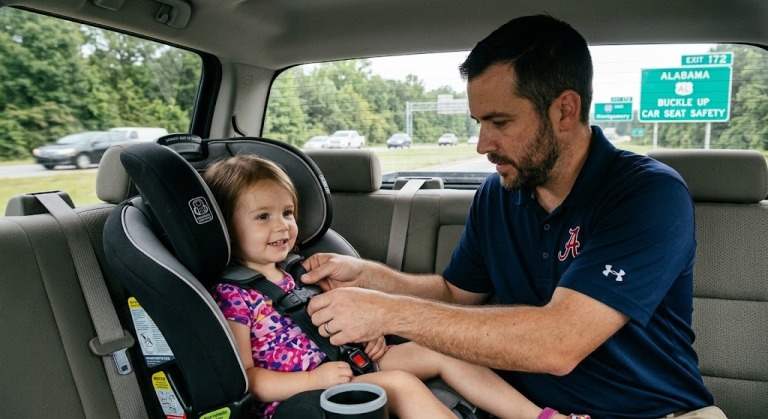
Alabama Car Seat Safety Laws: What Every Parent and Driver Needs to Know
If you drive a child anywhere in Alabama, the state has specific rules about how that child must be restrained. This guide walks through Alabama car seat safety laws stage by stage, explains what the fine looks like, points out where the law stops and best practice begins, and shows you how to get free help installing a seat correctly.
- Birth to age 1 or 20 pounds: rear-facing infant or convertible seat.
- Age 1 or 20 pounds up to age 5 or 40 pounds: forward-facing seat with a harness.
- Age 5 or 40 pounds up to age 6: booster seat.
- Ages 6 through 14: properly worn seat belt, at minimum.
- Penalty: a $25 fine per offense, and a court may dismiss it once you show proof of an appropriate restraint.
What is the car seat law in Alabama? A plain-English answer
People search for this in many ways: “car seat laws Alabama,” “Alabama law on car seats,” or “Alabama state car seat laws.” They all point to the same rule. Alabama requires every driver who transports a child to use a child restraint that fits the child’s age and size, and the rule stays in force until the child turns fifteen. What is the child car seats law in Alabama in practice? It works as a ladder: a rear-facing seat, then a forward-facing harness seat, then a booster, then the vehicle’s own belt.
Think of the law as a set of minimums written for the whole state, not a promise that a child is as safe as possible. Families who read the rest of this guide will see where common sense, and pediatric advice, asks for more than the statute does.
How Alabama’s child restraint law works
The rules live in Section 32-5-222 of the Code of Alabama. In plain terms, anyone who transports a child in a motor vehicle on the state’s roads must protect that child with a restraint system that meets federal motor vehicle safety standards and suits the child’s age and size. The duty falls on the person doing the driving, not only on the child’s parents.
The statute covers passenger cars, pickup trucks, minivans, SUVs, and vans built to seat ten or fewer people. Alabama’s current framework took effect on July 1, 2006. That update raised the age for required restraint from three to fifteen and introduced the booster seat stage, which is why most of today’s Alabama child car seat requirements look the way they do.
One detail surprises many families: the law sets minimum standards, and the minimum is not the same as the safest choice. Later sections show where pediatric guidance goes further than the statute.
How Alabama’s child car seat rules developed
The current rules did not appear overnight. According to the Alabama Department of Public Health, the first child seat law in 1982 covered children under three years old. A later change in 1989 broadened who was covered, and the 2006 update extended required restraint to children under fifteen and added the age-and-weight stages parents follow today.
That history explains why older relatives sometimes remember a much looser rule. Grandparents who raised children in the 1980s may not know that a child of five is now expected to ride in a booster or harness, not just a lap belt. A friendly reminder beats an argument in the driveway.
Who is responsible for compliance?
The statute speaks to “every person” transporting a child. That includes parents, grandparents, aunts and uncles, babysitters, neighbors in a carpool, and coaches driving a team home. If you are behind the wheel, the responsibility is yours, and it does not matter that the child belongs to someone else.
Alabama car seat requirements by age and weight
The statute moves a child through four stages. The table gives you the quick reference; the paragraphs below explain what each stage means in a real car.
| Stage | Required restraint | Minimum before moving on |
|---|---|---|
| Infants | Rear-facing infant-only or convertible seat | At least age 1 or 20 pounds |
| Toddlers and preschoolers | Forward-facing convertible or harnessed seat | At least age 5 or 40 pounds |
| Young school-age children | Booster seat | Until age 6 |
| Older children | Vehicle seat belt | Required through age 14 |
Stage 1: rear-facing seats
Newborns and infants must ride rear-facing in either an infant-only seat or a convertible seat set up to face the back. The legal floor is one year of age or 20 pounds. Rear-facing seats cradle the head, neck, and spine, spreading crash forces across the whole shell rather than pulling a small body forward against straps.
Stage 2: forward-facing seats with a harness
Once a child passes the rear-facing minimum, Alabama law calls for a forward-facing convertible or harnessed seat until at least age five or 40 pounds. The five-point harness keeps the shoulders, hips, and torso in place. Use the top tether whenever the seat has one, because it reduces how far the head can travel in a collision.
Stage 3: booster seats
From the end of the forward-facing stage until age six, a child needs a booster seat. Boosters lift the child so the lap and shoulder belt cross the strong parts of the body: the upper thighs and the middle of the chest. Without one, an adult belt often rides across the stomach and neck, which can cause serious injuries. A high-back booster is a better choice in vehicles with low seat backs or no headrests, while a backless booster works when the vehicle’s headrest supports the child’s head.
Stage 4: the seat belt
Children between six and fifteen must use a seat belt. Passing the legal threshold does not mean the belt fits, though. Check that the lap belt lies low across the upper thighs, the shoulder belt crosses the collarbone and chest, the child’s back rests against the seat, and their knees bend naturally at the edge of the cushion.
Types of car seats compared
Knowing the law is half the job. The other half is choosing a seat that suits your child and your vehicle. Here is how the main categories differ.
| Seat type | Typical use | Good to know |
|---|---|---|
| Infant-only seat | Newborns and small babies, rear-facing only | Portable carrier that clicks into a base; outgrown sooner than other seats |
| Convertible seat | Rear-facing first, then forward-facing | Stays in the car; higher rear-facing limits let children ride safer for longer |
| All-in-one seat | Rear-facing, forward-facing, then booster | Lasts the longest, but can be bulky and harder to move between cars |
| Combination seat | Forward-facing harness, then booster | Harness comes out when the child is ready for the belt-positioning stage |
| High-back booster | Children who have outgrown a harness | Supports the head and guides the shoulder belt; best where headrests are low |
| Backless booster | Older children in seats with head support | Compact and portable, but offers no side or head support of its own |
Price does not decide safety. Every seat sold for use in a vehicle must meet the same federal standards, so a correctly installed mid-priced seat can protect a child just as well as a premium one. Fit to the child and the car matters more than the brand.
Where the law ends and expert advice begins
Alabama car seat safety laws set the legal minimum. Pediatric guidance and the state’s own health department recommend keeping children in each stage longer.
| Stage | What Alabama law requires | What safety experts recommend |
|---|---|---|
| Rear-facing | Until age 1 or 20 lbs | Until age 2, or until the seat’s maximum height or weight limit |
| Forward-facing | Until age 5 or 40 lbs | Harness as long as possible, up to the seat’s limits |
| Booster | Until age 6 | Until the belt fits, typically about 4 ft 9 in and between ages 8 and 12 |
| Seat belt | Ages 6 through 14 | Lap and shoulder belt, in the back seat until age 13 |
The five-step seat belt fit test
How do you know when a child is truly ready to leave the booster behind? Have them sit in the vehicle seat without a booster and check five things:
- Their back rests fully against the vehicle seat.
- Their knees bend comfortably over the edge of the seat cushion.
- The lap belt sits low on the upper thighs, not on the soft stomach.
- The shoulder belt crosses the middle of the shoulder and chest, not the neck or face.
- They can stay seated this way for the entire trip, including when they fall asleep.
If even one answer is no, the child needs the booster a while longer. For many children this happens somewhere between eight and twelve years old, well past the age the statute requires.
Front seat or back seat?
The statute itself does not name an age for riding up front, but the Alabama Department of Public Health advises that every child under 13 ride in a rear seat. Front airbags are designed for adult bodies and can injure a child during deployment. A rear-facing seat must never be placed in front of an active airbag.
If your vehicle only has a front row, such as some pickup trucks, talk to a certified child passenger safety technician about your options. Many inspection stations can advise on disabling a passenger airbag where the vehicle allows it.
Fines and penalties for violating the law
Under current law, breaking the child restraint statute carries a fine of $25 per offense, and reports on the law note a license point can accompany a conviction. A judge may dismiss the charge, without court costs, when you prove you have since acquired an appropriate child restraint.
The money is small, but the real cost is not. In a crash, an unrestrained or wrongly restrained child faces far greater risk of injury. A citation can also complicate an insurance claim, because the other side may argue the child’s injuries were made worse by an improper restraint. If you are dealing with a citation, our overview of traffic ticket lawyers explains when it is worth getting professional advice.
Exemptions to the requirement
The law recognizes a few narrow exceptions:
- Medical reasons: a licensed physician can provide a written statement when a child’s condition prevents use of a standard restraint.
- Taxis and emergency vehicles: these are generally outside the requirement, although bringing your own seat is strongly encouraged.
- Larger vehicles: the statute is written for vehicles seating ten or fewer, so it does not cover buses in the same way.
Do not assume an exemption applies to your situation. If a doctor’s statement is involved, keep a copy in the vehicle.
How the law applies in real-life situations
Visiting from another state
The law applies to vehicles operated on Alabama roads, so families driving through or vacationing in the state should follow it even if their home state’s rules are different. The safest habit is to follow whichever rule is stricter.
Carpools, babysitters, and grandparents
Anyone who drives a child needs the correct seat. If a relative or sitter will be doing pickups, install the seat with them ahead of time and show them how to tighten the harness. A quick practice run takes ten minutes and prevents most errors.
Rideshares and taxis
Taxis are generally outside the requirement, but the statute does not clearly address app-based rides, and a crash does not care about the rules. If you plan to use a rideshare with a young child, bring a lightweight seat, such as a compact travel-friendly model, and install it before you set off.
Pickup trucks and vehicles with limited seating
The law covers pickups, but a truck with only a front row creates a real problem for rear-facing seats and airbags. Speak with a certified technician about your specific vehicle before you buy a seat.
Premature babies and children with medical needs
Some babies leave the hospital with special positioning needs, and some children need adaptive seating. Ask your pediatrician for guidance and, if a standard restraint really cannot be used, get the physician’s written statement described in the exemptions section and keep it in the car.
Adopted, foster, or blended-family travel
Children arrive at different sizes and stages, and the law follows each child’s own age and weight, not the household’s. Check every child before every trip, especially when a new child joins the car.
Proposed changes: what HB32 would do
During the 2026 regular session, House Bill 32 was introduced to update Alabama car seat safety laws. As introduced, it would extend rear-facing use to at least age 2 or 35 pounds, require forward-facing seats until at least age 5 or 65 pounds, and keep children in a belt-positioning booster until at least age 6 and until the seat belt fits properly. It would also raise fines for repeat violations within five years, from $25 up to $150 for a fourth or later offense, and direct part of the money toward providing seats to low-income families.
Choosing, installing, and checking your seat
Pick the right type
Match the seat to your child’s height, weight, and age, and confirm it is labeled as meeting federal standards.
Read both manuals
Your vehicle manual and the seat manual each cover installation details, including where to use the seat belt or the LATCH system.
Get it tight
Once installed, the seat should not move more than about an inch side to side or front to back at the belt path.
Check the harness
Straps should lie flat, sit snug with no pinchable slack at the shoulder, and the chest clip should rest at armpit level.
You do not have to figure this out alone. The Alabama Department of Public Health lists car seat inspection stations where trained technicians offer free help choosing a seat and demonstrating a correct installation in your own vehicle.
Also replace any seat that has been in a moderate or severe crash, and check the expiration date molded into the plastic. Materials degrade over time, and an expired seat may not perform as tested.
Everyday and seasonal safety tips
Alabama’s long, hot summers create risks that have nothing to do with the statute. Car seat buckles and metal parts can burn a child’s skin after sitting in the sun, so check the surface before you buckle in, and use a sunshade when parked. Never leave a child alone in a vehicle, even briefly.
In cooler months, thick coats compress in a crash and leave the harness too loose. Buckle the child in first, then lay a coat or blanket over the harness. Toys and loose items should be soft and secured, because anything unsecured becomes a projectile in a sudden stop.
Finally, register your seat with the manufacturer. Registration lets the company contact you if a recall is issued, which is one of the simplest safety steps a parent can take.
Common mistakes that put children at risk
- Turning a child forward-facing the moment they reach the legal minimum.
- Moving to a booster before the child can sit properly for the entire trip.
- Leaving the harness loose or the chest clip too low.
- Using bulky winter coats under the harness, which creates hidden slack.
- Installing a seat with both the LATCH system and the seat belt when the manual allows only one.
- Buying a used seat with an unknown crash history.
- Letting a child slip the shoulder belt behind their back.
A quick pre-trip checklist
Seat
Correct type for the child’s size, not expired, no crash history, and installed tightly.
Harness
Snug straps, chest clip at armpit level, no thick clothing underneath.
Position
Back seat for children under thirteen; rear-facing seats never in front of an active airbag.
Driver
Every passenger buckled, the child settled, and no one distracted before you pull away.
If a child is hurt in a crash
After any collision, get every child checked by a medical professional even if they seem fine, since some injuries appear later. Keep the car seat, photograph the installation and damage if you can, and save medical records and repair estimates.
If another driver caused the collision, the family may be able to pursue compensation for medical bills and related losses. Our guides on car accident lawyers and personal injury compensation explain how claims work, and you can find a personal injury lawyer to review your options. Whether a car seat was used correctly can come up during a claim, so accurate records matter.
Frequently asked questions about Alabama car seat safety laws
What are the car seat laws in Alabama?
Children ride rear-facing until at least age 1 or 20 pounds, forward-facing with a harness until at least age 5 or 40 pounds, and in a booster until age 6. Children through age 14 must then use a properly worn seat belt.
What is the fine if I break the law?
The fine is $25 per offense. A judge may dismiss the case if you show proof of acquiring an appropriate restraint.
When can my child stop using a booster seat?
The statute requires one until age six. Experts recommend continuing until the belt fits correctly, usually around 4 feet 9 inches tall, often between ages 8 and 12.
Can my child ride in the front seat?
The law does not set a specific front-seat age, but the state health department recommends the back seat for every child under 13.
Does the law apply to rideshares and taxis?
Taxis are generally exempt from the requirement, but a crash does not care about exemptions. Bringing your own seat is the safest approach.
Where can I get my car seat checked for free?
Certified technicians at inspection stations listed by the Alabama Department of Public Health can check your installation and show you how to fix problems.
What is the car seat law in Alabama for a 4-year-old?
A four-year-old is in the forward-facing stage. Alabama law requires a forward-facing harness seat until at least age five or 40 pounds, and many children are safer staying in the harness beyond that if the seat’s limits allow.
Is a 5-year-old required to use a booster seat?
After the forward-facing stage ends at five years or 40 pounds, the statute calls for a booster seat until age six. Safety experts advise keeping a booster longer, until the belt fits correctly.
Do Alabama state car seat laws apply to older children?
Yes. Children between six and fifteen must be restrained by a seat belt, and health officials recommend that every child under thirteen ride in the back.
Can I get a car seat if I cannot afford one?
Many local health departments, hospitals, and safety programs help low-income families. Ask an inspection station or your county health office what is available near you.
Do I need to replace a car seat after a minor accident?
Guidance depends on the crash severity and the manufacturer’s instructions. Replace a seat after any moderate or severe collision, and check the manual for what counts as minor.
The bottom line on Alabama car seat laws
Alabama car seat safety laws give you a clear floor: rear-facing to at least one, harnessed to at least five, boosted until six, then belted. The safest families treat those numbers as a starting point, keep children in each stage as long as the seat allows, and get their installation checked. If you have questions about a citation or a crash involving a child, you can ask a legal question and get pointed toward the right kind of help.
This article is general information, not legal advice. Laws change, so confirm current requirements with official Alabama sources or a licensed attorney.