Accident Attorney in Albany, GA: What You Need to Know Before You File a Claim
A practical, plain-English guide to how injury claims actually work in Dougherty County — from fault rules and filing deadlines to what an accident attorney does with your case behind the scenes.
One minute you’re merging onto US-19 or waiting at a light on Westover Boulevard, and the next you’re dealing with a wrecked car, an ambulance ride, and a claims adjuster who’s already calling your phone. Most people never plan for that moment, which is exactly why the days right after a collision tend to be the most confusing. You’re managing pain, missed work, a rental car, and a stack of paperwork — all while an insurance company that does this every single day is quietly building a file against you.
This is the point where an experienced accident attorney in Albany, GA stops being optional and starts being the difference between a fair settlement and a lowball check. This guide walks through what these attorneys actually do, how Georgia’s fault and injury laws work, what your claim might be worth, and how to choose the right representation for your situation — without the sales pitch you’ll find on most law firm websites.
What an Accident Attorney in Albany, GA Actually Does
The public image of a personal injury lawyer is someone who shows up in court. In reality, the vast majority of the work happens long before a courtroom is ever involved, and it’s largely invisible to the client. A qualified accident attorney typically handles:
- Case investigation — pulling the police report, photographing the scene and vehicle damage, and identifying every party who may share liability.
- Medical coordination — making sure your treatment is properly documented and connected to the crash, which matters enormously when an insurer tries to argue your injury came from somewhere else.
- Damage calculation — adding up medical bills, lost income, property damage, and future costs, then translating that into a demand that reflects the real value of the claim rather than a guess.
- Insurance negotiation — communicating with adjusters directly so you’re not pressured into a recorded statement or an early settlement that undervalues your case.
- Litigation, if necessary — filing suit in Dougherty County State or Superior Court and preparing for trial when an insurer refuses to negotiate in good faith.
In short, the attorney’s job is to remove the burden of proof from your shoulders during a period when you’re supposed to be healing, not fighting a claims department.
Types of Accident Cases Handled Locally
“Accident attorney” is a broad title because it covers several very different practice areas, each with its own evidence rules and insurance dynamics. Around Albany, the most common categories include:
- Car accidents — rear-end collisions, intersection crashes, and multi-vehicle pileups, which remain the most frequent reason people search for legal help after a wreck.
- Truck and commercial vehicle accidents — cases involving freight carriers or delivery vehicles, which bring in federal trucking regulations and often multiple insurance policies.
- Motorcycle accidents — collisions where injuries tend to be more severe and insurers frequently try to shift blame onto the rider.
- Pedestrian accidents — crashes at crosswalks, parking lots, and residential streets where a driver failed to yield.
- Bicycle accidents — a growing category as more commuters and students share the road with vehicle traffic.
- Rideshare accidents — Uber and Lyft cases, which involve layered commercial insurance policies that differ depending on whether the driver was logged into the app.
- Slip-and-fall and premises liability — injuries caused by unsafe conditions on someone else’s property, from wet floors to poor lighting in a parking lot.
- Dog bites — a distinct area of Georgia injury law with its own liability standard for owners.
- Wrongful death — claims brought by surviving family members when a crash or negligent act results in a fatality.
Each category has its own quirks, so the right auto accident lawyer in Albany, GA for a rear-end fender bender may not be the strongest fit for a commercial truck case involving federal safety violations. It’s worth asking any attorney you consult how much of their caseload actually matches your specific type of accident.
Where Accidents Tend to Happen Around Albany
Certain corridors see a disproportionate share of Dougherty County collision reports, largely because of heavy commuter traffic mixed with commercial vehicles and frequent turning movements. Roads that come up often in local crash discussions include US-19 (Slappey Boulevard/Liberty Expressway), Westover Boulevard, Sylvester Road, Dawson Road, Gillionville Road, and the intersections feeding into downtown Albany. High-traffic retail corridors and shopping center parking lots also generate a steady stream of low-speed collisions and premises liability claims. None of that means every crash happens on a “dangerous road” — most come down to a driver who was distracted, speeding, or failed to yield — but knowing the local traffic pattern helps an attorney reconstruct how a specific collision likely occurred.
Understanding Georgia’s Fault Rule (Why the Percentage Matters)
Georgia is an at-fault state, meaning the driver who caused the crash — and their insurance company — is financially responsible for the resulting harm. But very few accidents involve one driver who is 100% at fault and one who is completely blameless. That’s where Georgia’s modified comparative negligence rule under O.C.G.A. § 51-12-33 comes in.
Under this rule, you can still recover compensation even if you were partly responsible for the crash — as long as your share of fault is under 50%. If you’re found to be 50% or more at fault, Georgia law bars you from recovering anything at all. When you are under that threshold, your total award is simply reduced by your percentage of fault.
| Your Share of Fault | Total Claim Value | What You Can Recover |
|---|---|---|
| 0% | $100,000 | $100,000 |
| 20% | $100,000 | $80,000 |
| 49% | $100,000 | $51,000 |
| 50% or more | $100,000 | $0 (barred from recovery) |
This is exactly why insurance adjusters spend so much time trying to assign you even a small percentage of blame — every point they can shift onto you directly reduces what they have to pay, and pushing you to 50% eliminates the payout entirely. A local accident attorney knows how to counter these arguments with police reports, witness statements, and physical evidence before the fault percentage gets locked in.
How Long Do You Have to File? Georgia’s Statute of Limitations
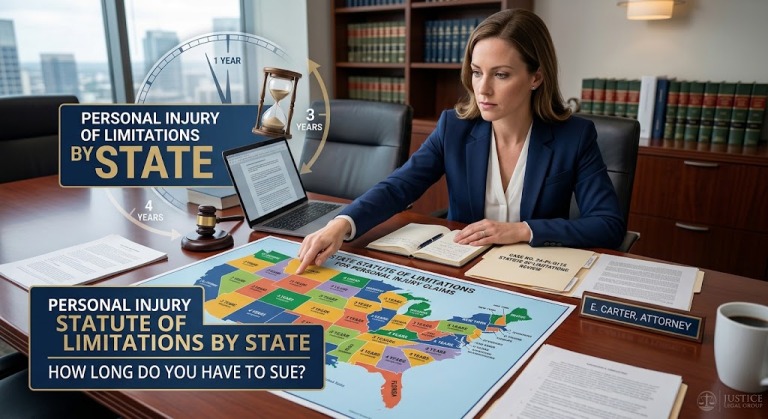
Georgia law gives most personal injury victims two years from the date of the accident to file a lawsuit. That deadline applies to car accidents, truck accidents, slip-and-falls, and most other negligence-based injury claims. A few important exceptions can shorten or complicate that window:
- Claims against a city, county, or state government entity (for example, a crash involving a municipal vehicle or a dangerous condition on a public road) require a formal “ante litem” notice, often within six months to a year — far sooner than the general two-year deadline.
- Property damage claims generally carry a four-year statute of limitations, separate from the injury claim.
- Wrongful death claims generally follow the same two-year rule, but the clock and the eligible claimants can shift depending on the circumstances.
Why it matters: Missing the filing deadline doesn’t just weaken your case — it typically ends it completely, regardless of how strong the evidence is. If a government vehicle or agency was involved, treat the timeline as urgent rather than routine.
What Compensation Can Include
Every claim is different, but Georgia law generally allows injured accident victims to pursue two broad categories of damages, which a personal injury attorney will document separately:
Economic Damages
- Emergency treatment, surgery, physical therapy, and future medical care
- Lost wages and reduced earning capacity if the injury affects your ability to work
- Vehicle repair or replacement and other property losses
- Out-of-pocket costs such as transportation to appointments or in-home care
Non-Economic Damages
- Pain and suffering
- Emotional distress
- Permanent disability or disfigurement
- Loss of enjoyment of life
In rare cases involving especially reckless conduct — such as drunk driving — Georgia also allows punitive damages, which are intended to punish the at-fault party rather than compensate the victim. For a deeper breakdown of how these categories are calculated and negotiated, see this guide to personal injury compensation.
Steps to Protect Your Claim After an Accident
What you do in the first hours and days after a crash has an outsized impact on the eventual outcome of your claim. A few consistent habits go a long way:
- Get medical attention immediately, even if injuries seem minor — some soft-tissue and head injuries don’t show symptoms right away, and a documented gap in treatment gives insurers an opening to dispute causation.
- Call the police and get a report number so there’s an official, timestamped record of the crash.
- Photograph everything — vehicle damage, road conditions, skid marks, traffic signals, and visible injuries.
- Collect witness information before people leave the scene; independent witnesses carry significant weight later.
- Avoid giving a recorded statement to the other driver’s insurer before speaking with an attorney — those calls are designed to lock in statements that can be used to minimize your claim.
- Keep every bill, receipt, and record related to the accident, including mileage to medical appointments and days missed from work.
- Avoid posting about the accident on social media — even a casual photo or comment can be taken out of context by defense attorneys.
Insurance Tactics Worth Knowing About
Insurance companies are businesses first, and their claims process is built to control payouts. Some patterns come up often enough that it’s worth recognizing them in advance:
- The fast, friendly early offer — a quick settlement that arrives before your medical treatment is even finished, usually well below the claim’s true value.
- Requests for a recorded statement — framed as routine, but often used to extract wording that can later be used to argue you were partly at fault.
- Delayed responses — hoping financial pressure will push you toward accepting less.
- Disputing the medical connection — arguing an injury is pre-existing or unrelated to the crash, especially for soft-tissue and back injuries that don’t show clearly on imaging.
- Surveillance — particularly in claims involving long-term disability, where adjusters may monitor social media or public activity for anything that contradicts the claimed injury.
None of this means every adjuster acts in bad faith, but it does explain why having someone on your side who negotiates claims for a living changes the leverage in the conversation.
How an Attorney Builds the Case Behind the Scenes
Strong settlements rarely happen by accident — they’re built on evidence gathered methodically while it’s still available. That typically includes police and crash reports, medical records tying injuries directly to the collision, photos and video from the scene, cell phone and dashcam data where relevant, accident reconstruction analysis for serious or disputed-fault crashes, and witness statements collected close to the event, while memories are still fresh. Once the file is complete, the attorney prepares a formal demand package — often built around a detailed demand letter — that lays out liability, damages, and supporting documentation before negotiations even begin. That level of preparation is often what separates a fair settlement from a lowball offer.
How Much Does an Accident Attorney in Albany, GA Cost?
Most personal injury and accident attorneys work on a contingency fee basis, meaning there’s no upfront cost to hire representation. The attorney’s fee — typically a percentage of the final settlement or verdict, commonly in the range of one-third — is only collected if the case results in a recovery. If there’s no settlement or award, you generally owe nothing for the attorney’s time. This arrangement also means the initial consultation is almost always free, which makes it low-risk to at least get a professional opinion on whether your case has merit before deciding how to proceed.
Choosing the Right Accident Attorney in Albany, GA
Not every accident attorney is the right fit for every case. A few factors are worth weighing before you commit to representation:
- Relevant case experience — a track record with the specific type of accident you were in (car, truck, motorcycle, premises liability, etc.), not just personal injury in general.
- Local court familiarity — knowledge of how Dougherty County courts, judges, and local insurance adjusters typically handle claims.
- Willingness to go to trial — insurers negotiate differently with attorneys who have a genuine reputation for taking cases to court when necessary, rather than settling everything quickly.
- Clear communication — you should know who’s handling your case day-to-day and how often you’ll get updates.
- Transparent fee structure — confirm the contingency percentage and what happens to case expenses if you don’t win.
Comparing more than one personal injury lawyer before committing is a reasonable step, especially for cases involving serious or long-term injuries where the choice of attorney can materially affect the outcome.
Frequently Asked Questions
How much does it cost to hire an accident attorney in Albany, GA?
Most work on contingency, meaning you pay nothing upfront and the fee — usually around a third of the final recovery — only applies if the case is won or settled.
What if I was partly responsible for the accident?
You can still recover compensation as long as you’re found to be less than 50% at fault under Georgia’s modified comparative negligence rule; your award is simply reduced by your percentage of fault.
How long does an accident claim typically take to resolve?
Straightforward claims can resolve in a few months, while cases involving serious injuries, disputed fault, or litigation can take a year or longer, since settlement usually waits until treatment has stabilized.
What happens if the other driver doesn’t have insurance?
If you carry uninsured/underinsured motorist (UM/UIM) coverage, your own policy may step in to cover the gap; an attorney can help determine what coverage applies and how to pursue it.
Will my case have to go to court?
Most personal injury claims settle before trial, but having an attorney who is prepared to litigate strengthens your negotiating position even if the case never reaches a courtroom.
How soon after an accident should I contact an attorney?
As early as possible — ideally before giving a recorded statement to any insurance company — since evidence, witness memory, and certain filing deadlines can all work against you the longer you wait.
Final Thoughts
Recovering from an accident is stressful enough without having to decode insurance jargon and Georgia’s fault laws at the same time. Whether you’re dealing with a routine fender bender or a serious injury with months of treatment ahead, an experienced accident attorney in Albany, GA can shoulder the legal and negotiation work so you can focus on getting better. The most important step is simply not waiting too long to ask a professional whether your claim is worth pursuing — most consultations are free, and the two-year clock on Georgia injury claims starts the day of the accident, not the day you decide to look into it.